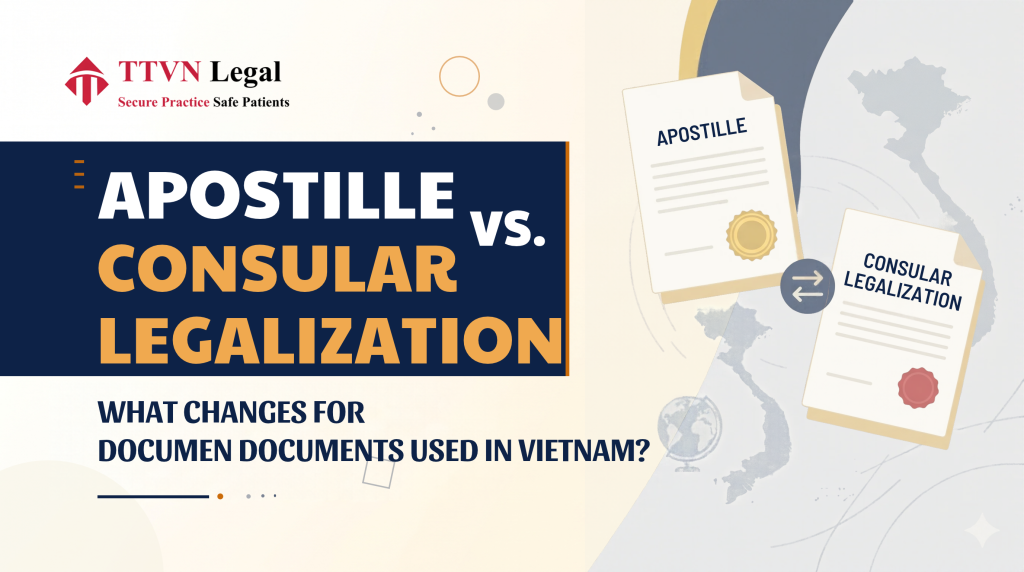
Cross-border corporate expansions and international healthcare operations in Vietnam require foreign public documents to be legally recognized by local authorities. On 23 July 2026, the Vietnamese Government enacted Decree No. 293/2026/ND-CP to implement the 1961 Hague Apostille Convention, taking effect on 11 September 2026. This landmark reform replaces the complicated consular legalization process with a simplified certification stamp known as an Apostille.
Eligible Foreign Documents in Business and Healthcare
Under Article 10 of Decree 293/2026/ND-CP, the Apostille framework covers a broad spectrum of administrative, judicial, and notarized public records. In the corporate sector, this includes articles of incorporation, certificates of good standing, board resolutions, and powers of attorney required for FDI registration, M&A transactions.
In the healthcare sector, the Apostille is particularly vital for international medical institutions, pharmaceutical firms, and foreign healthcare personnel. Essential medical paperwork includes foreign medical degrees, specialist diplomas, professional practicing licenses, foreign health certificates, medical examination reports, and criminal background checks required for foreign doctors and executives obtaining Vietnamese work permits (1).
Step-by-Step Practical Workflow
To successfully utilize apostilled foreign documents in Vietnam, businesses and executives, specifically in healthcare sector, should follow a three-step procedure:
Obtain the Apostille in the Country of Origin: While official public records (such as court rulings or state degrees) qualify directly for an Apostille, private records such as employment confirmation letters from private clinics or internal corporate resolutions do not. Accordingly, private documents must first be notarized by a licensed Notary Public in the country of origin. This notarization creates an official public act, allowing the foreign competent authority to issue an Apostille certifying the signature and seal of the Notary Public (2) (3).
Vietnamese Translation and Certification: Once apostilled, the document must be translated into Vietnamese, and the translator’s signature must be certified by an authorized notary or public office in Vietnam (4). Crucially, the Apostille must be affixed to the original document before translation, as the Apostille stamp itself must also be translated (5).
Submission to Local Agencies: The translated, apostilled file is submitted directly to licensing bodies, such as the Department of Health or Ministry of Labor, without any further consular verification (6).
Key Exceptions and Limitations
An Apostille certifies document origin – specifically the authenticity of the signature, seal, and capacity of the signer – not its content (7). Local authorities retain the right to evaluate document compliance under domestic laws (8). Furthermore, direct commercial or customs records are excluded from Apostille coverage (9). Finally, documents originating from non-member countries or jurisdictions objecting to Vietnam’s accession (such as Germany, Austria, and the Czech Republic) must continue using traditional consular legalization (10).
Legal References
Point a, Clause 3, Article 19 of Decree No. 219/2025/ND-CP.
Article 3(3) of Decree No. 293.
Article 11(1)(c) of Decree 293
Clause 1, Article 27 of Decree No. 293; Point c, Clause 1, Article 18 of the 2024 Law on Notarization.
Clause 1, Article 16 and Clause 1, Article 4 of Decree No. 293/2026/ND-CP. Vì tem Apostille đóng/dán trực tiếp lên văn bản và là một phần không thể tách rời của giấy tờ công, nên khi mang về Việt Nam sử dụng, toàn bộ nội dung tem Apostille cũng phải được dịch sang tiếng Việt. Do đó, để tối ưu về mặt quy trình, văn bản nên được dán tem Apostille hoàn chỉnh ở nước ngoài trước, rồi mới tiến hành dịch toàn bộ (bao gồm cả nội dung tem) và chứng thực chữ ký người dịch tại Việt Nam
Clause 2, Article 27 of Decree No. 293.
Article 4 of Decree No. 293.
Clause 2, Article 33 of Decree No. 293.
Article 11 of Decree No. 293.
Point b, Clause 3, and Clause 4, Article 5 of Decree No. 293.
Notes: This article is provided for informational purposes only and does not constitute legal advice. The views and interpretations expressed herein reflect those of TTVN Legal as of the date of publication and may be subject to change without prior notice.