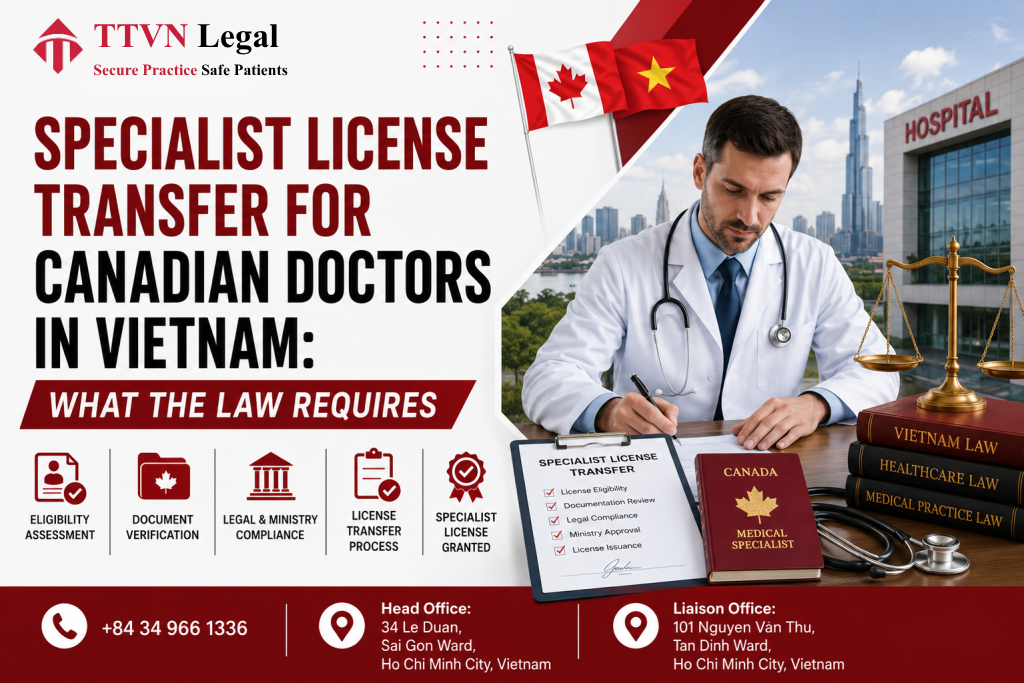
‘License transfer’ is a term commonly used by Canadian physicians considering practice in Vietnam—but it is important to understand that Vietnam does not operate a straightforward license transfer system. Instead, the Vietnamese framework requires a formal recognition of the foreign-issued license followed by issuance of a new Vietnamese license. This distinction has significant practical implications for Canadian doctors planning their transition.
This guide explains exactly what Vietnamese law requires for Canadian doctors seeking to practice with their Canadian specialist credentials, and how the process differs from what ‘transfer’ implies.
Recognition, Not Transfer: The Legal Framework
Under Articles 29 and 30 of the Law on Medical Examination and Treatment 2023, and Articles 13, 14, 37, and 38 of Decree 96/2023/ND-CP, Vietnam requires a two-step process:
1. Recognition of the foreign-issued license: The Vietnamese MOH formally evaluates the Canadian license and the issuing authority (the relevant provincial College of Physicians and Surgeons) and issues a recognition decision. 2. Issuance of a Vietnamese medical practice license: Based on the recognition decision, a Vietnamese practice license (giay phep hanh nghe) is issued, specifying the professional title and scope of practice.
The Canadian license itself does not become valid in Vietnam—rather, it serves as the basis for issuing a separate Vietnamese license. This is a recognition process, not a transfer.
Eligibility Conditions for Canadian Specialists
For Canadian doctors to qualify for the recognition process, their Canadian specialist license must:
Be currently valid and in good standing with the provincial College of Physicians and Surgeons;
Correspond to a professional title recognized under Vietnamese law;
Have been issued by an authority either recognized under an international treaty to which Vietnam is a party, or assessed and recognized by the Vietnamese MOH.
Additionally, the applicant must be:
A Vietnamese citizen, OR
Currently working at a licensed Vietnamese healthcare facility, OR
Holding a valid Vietnamese work permit.
For most Canadian specialists, the work permit pathway is most relevant, meaning the employment contract and work permit must be secured before or concurrent with the license recognition application.
Specialist Equivalency Assessment
A critical step for Canadian specialists is the MOH’s assessment of specialty equivalency—verifying that the Canadian specialty designation maps to a recognized Vietnamese professional title and scope of practice.
Canadian specialists (e.g., those certified by the Royal College of Physicians and Surgeons of Canada in cardiology, orthopedic surgery, or neurology) generally find good equivalency with Vietnamese specialist categories. However, some Canadian subspecialties may not have a direct Vietnamese equivalent, requiring a case-by-case assessment by the MOH.
Documents supporting specialist equivalency include:
Royal College fellowship certificate;
Residency and subspecialty training completion certificates;
Academic transcripts from specialty training programs;
Letter of good standing from the Royal College;
CV detailing clinical experience in the specialty.
All documents must be apostilled and translated into Vietnamese by a certified translator.
Provincial College Assessment by Vietnamese MOH
Each Canadian provincial College of Physicians and Surgeons is a separate licensing authority. The Vietnamese MOH may have assessed some provincial colleges but not others. If the specific provincial college that issued the Canadian doctor’s license has not been previously assessed by the MOH, an additional assessment period applies before the 30-day review clock starts.
This assessment examines the provincial college’s:
Medical training standards and curriculum;
Licensing conditions and procedures;
Scope of professional practice titles;
Disciplinary and oversight mechanisms.
Canadian doctors should proactively inquire (through a Vietnamese legal advisor) about the assessment status of their provincial college before filing the recognition application.
The Vietnamese Practice License: What It Specifies
Once recognition is granted and the Vietnamese practice license is issued, the license will specify:
The doctor’s full name and personal identification information;
Professional title (e.g., bac sy chuyen khoa – specialist physician);
Scope of practice (e.g., tim mach – cardiology; chinh hinh – orthopedics);
The healthcare facility at which the license is registered;
Validity period and license number.
Canadian specialists should review the draft license carefully to ensure the specialty scope is accurately described. Corrections after issuance require a formal amendment application and additional processing time.
Maintaining Good Standing Across Jurisdictions
Canadian doctors practicing in Vietnam must maintain their Canadian provincial license in good standing. Vietnamese regulatory authorities may verify the status of the underlying Canadian license during renewal of the Vietnamese practice license. A suspended or revoked Canadian license may be grounds for revocation of the Vietnamese license.
Canadian doctors should also maintain their continuing medical education (CME) requirements for their Royal College fellowship, as Vietnamese license renewals may require evidence of ongoing professional development in the relevant specialty.
Conclusion
Canada’s provincial specialist licensing system is respected by the Vietnamese MOH, but the process is recognition-based—not a simple transfer. Canadian specialists must navigate the MOH recognition pathway, support the assessment of their provincial college if required, and ensure their specialty is correctly mapped to Vietnamese categories. TTVN Legal assists Canadian specialist physicians with every stage of the recognition and licensing process in Vietnam.
Need expert legal support for healthcare investment in Vietnam? TTVN Legal | 101 Nguyen Van Thu, Tan Dinh Ward, Ho Chi Minh City, Vietnam +84 349661336 | tham@ttvnlegal.com.vn | https://ttvnlegal.com.vn/