
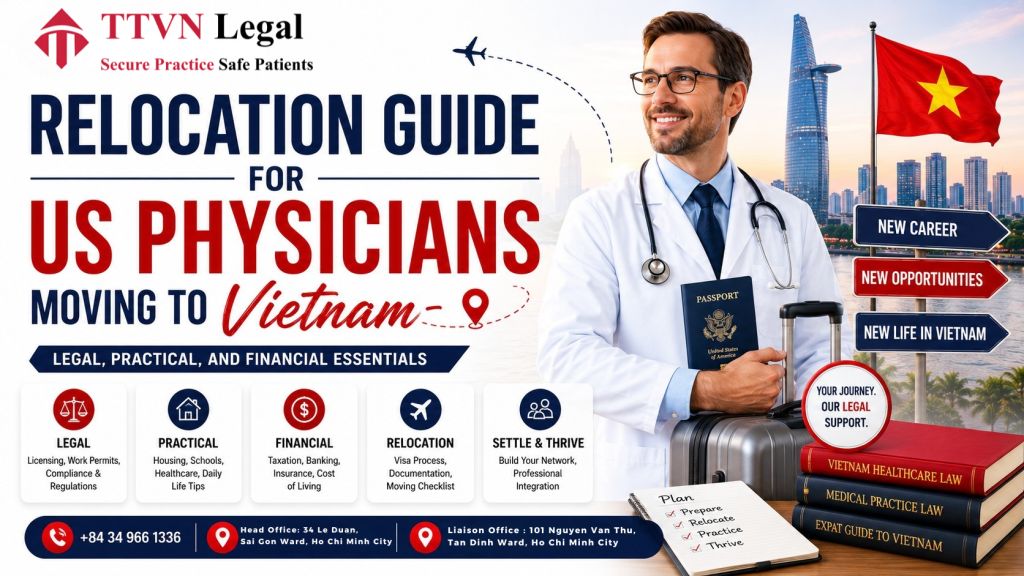
Relocating from the United States to practice medicine in Vietnam is a significant undertaking—legally, logistically, and personally. Beyond the medical licensing process, US physicians must navigate immigration, employment, housing, schooling, banking, and tax planning across two jurisdictions with very different legal and administrative systems.
This guide provides a comprehensive relocation overview for US physicians moving to Vietnam, covering the key legal steps, practical preparations, and financial considerations to ensure a smooth transition.
Phase 1: Pre-Departure Legal Preparation (3–6 Months Before Move)
The most important pre-departure legal steps for US physicians are:
1. Secure a job offer or investment plan: Without either an employment contract from a Vietnamese hospital or a clear plan for clinic ownership, it is not possible to begin the licensing or work permit process. 2. Start the credential recognition process: Submit the dossier for recognition of the US medical license to the Vietnamese MOH’s Department of Medical Services Administration under Article 29 of the Law on Medical Examination and Treatment 2023. This should be initiated as early as possible—ideally 6 months before the intended start date. 3. Obtain apostilles: All US-issued documents (medical license, medical degree, criminal background check, transcripts) must be apostilled through the relevant US state secretary of state. Begin this process early as some apostilles require waiting periods. 4. Engage a Vietnamese healthcare lawyer: The licensing process involves multiple regulatory agencies, and professional legal support from the outset significantly reduces the risk of delays and rejected applications.
Phase 2: Immigration and Entry
US citizens may enter Vietnam under an e-visa (valid for up to 90 days) or under the visa exemption arrangement. However, for work purposes:
An e-visa or tourist/business visa does not authorize employment. US physicians must obtain a work visa (LD category) once a work permit is issued.
Work permits: Applied for by the employer (Vietnamese hospital or clinic) with DOLISA after the employment contract is signed. Processing: 7–15 working days. Requires proof of qualifications, health certificate, criminal check, and employer’s labor need certificate.
Temporary Residence Card (TRC): Issued after the work permit; provides multi-entry residence authorization for the duration of the work permit (up to 2 years).
Family members: A spouse and children under 18 may apply for dependent visas or TRCs. Dependent TRCs are generally straightforward for immediate family of TRC holders.
Housing and Living Arrangements
US physicians in Vietnam typically live in serviced apartments or standard lease apartments in central urban areas. Key considerations:
Lease terms: Most landlords require 3–12 month leases with a security deposit of 2–3 months’ rent. Foreigners can legally rent residential property in Vietnam.
Location: Proximity to the employing hospital is usually the top priority. Ho Chi Minh City’s Districts 1, 2, 3, and 7 are popular expatriate residential areas with easy access to major international hospitals.
Cost: A well-furnished 2-bedroom apartment in central HCMC typically ranges from USD 800–1,800/month; in Hanoi from USD 700–1,500/month.
International schools: For US physicians with children, international schools (American, British, IB curriculum) are available in HCMC and Hanoi but have waiting lists and annual fees of USD 15,000–30,000.
Many international hospitals negotiate housing allowances as part of the employment package—US physicians should maximize this element in contract negotiations.
Banking and Financial Setup
US physicians working in Vietnam should set up a Vietnamese bank account for salary receipt and daily expenses:
Most international banks operating in Vietnam (HSBC, ANZ, Citibank) offer English-language services and can accommodate foreign nationals with work permits.
Domestic Vietnamese banks (Vietcombank, Techcombank, MB Bank) offer high-quality digital banking services and wide ATM networks.
Salary remittance to the US: Foreign employees in Vietnam can legally transfer their after-tax salary to the US through licensed commercial banks, subject to evidence of tax compliance.
US FBAR/FATCA obligations: US citizens with foreign bank accounts exceeding USD 10,000 at any point in the year must file an FBAR (FinCEN Form 114) with the US Treasury. US physicians should ensure compliance from the month they open a Vietnamese bank account.
Healthcare and Insurance for US Physicians in Vietnam
Despite working in the healthcare sector, US physicians in Vietnam need their own comprehensive health coverage:
International health insurance: Most international hospitals provide group health insurance as part of the employment package. US physicians should confirm the coverage includes medical evacuation, pre-existing conditions, and repatriation.
US health insurance: Standard US health insurance plans typically do not provide coverage for treatment received outside the US (except emergency care). US physicians should review their US plan’s terms and consider a gap policy or suspension of coverage if long-term abroad.
Malpractice/professional liability: Confirm employer coverage as outlined in the compliance sections above.
Cultural and Professional Adaptation
US physicians in Vietnam often note a significant adjustment in the following areas:
Communication style: Vietnamese professional culture tends toward indirect communication and hierarchical decision-making. US physicians accustomed to flat organizational cultures should approach this with openness.
Patient expectations: Patients at international hospitals expect high standards but may have different baseline medical knowledge and attitudes toward diagnosis and treatment than US patients.
Documentation: Clinical documentation requirements are rigorous but the format and language (Vietnamese) may differ from US practice.
Language: Even in English-medium hospitals, some Vietnamese language ability significantly improves professional relationships and patient interactions. A Vietnamese language course before or immediately after arrival is strongly recommended.
Conclusion
Relocating to Vietnam as a US physician is a rewarding but logistically intensive process. Early preparation across legal, immigration, financial, and personal domains is the key to a smooth transition. TTVN Legal provides relocation legal support packages for US physicians, covering the full spectrum from credential recognition through to work permit, visa, and clinic setup assistance.
Need expert legal support for healthcare investment in Vietnam? TTVN Legal | 101 Nguyen Van Thu, Tan Dinh Ward, Ho Chi Minh City, Vietnam +84 349661336 | tham@ttvnlegal.com.vn | https://ttvnlegal.com.vn/