Australian investors entering Vietnam’s dental clinic market face a fundamental strategic decision: establish a 100% foreign-owned entity, or partner with a Vietnamese co-investor in a joint venture (JV)? Both structures are legally permissible, but each has distinct advantages, risks, and compliance implications.
This guide provides a balanced analysis of joint venture versus 100% foreign ownership for Australian dental investors, with reference to Vietnam’s investment and healthcare regulatory framework.
The Legal Baseline: Both Are Permitted
Under Vietnam’s Law on Investment 2020 and WTO commitments, Australian investors may:
Establish a 100% foreign-owned company to own and operate a dental clinic, or
Form a joint venture with one or more Vietnamese partners, with any agreed ownership split (subject to compliance with investment registration requirements).
Neither structure is inherently preferred by Vietnamese regulations for dental clinics specifically—the choice is a strategic and commercial decision rather than a legal requirement.
Advantages of 100% Australian Ownership
Full ownership provides:
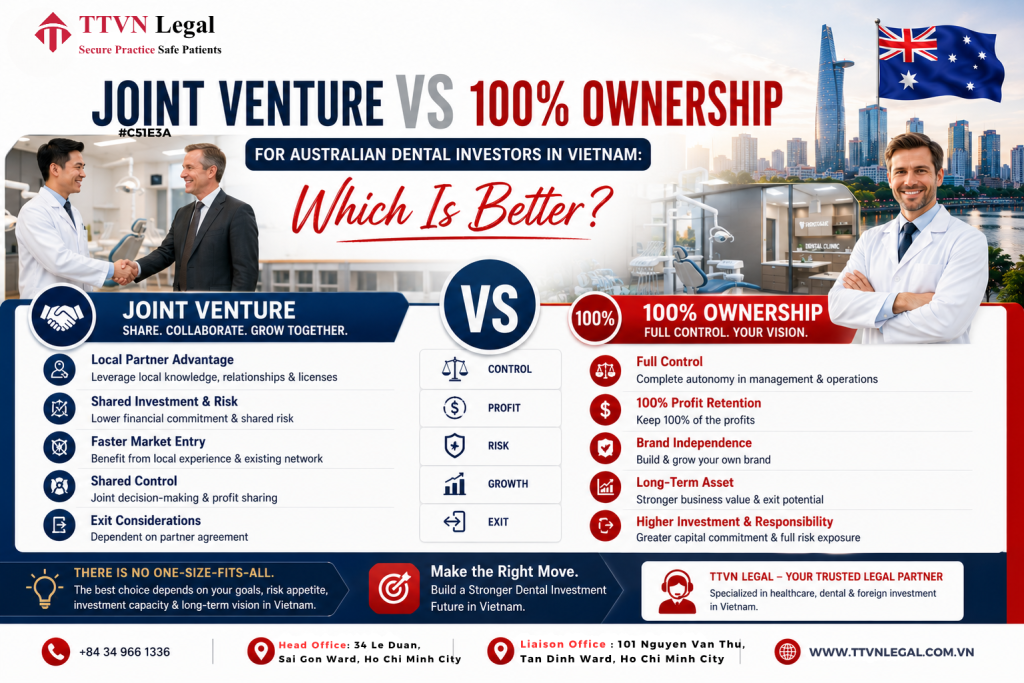
Complete operational control: All decisions on clinical protocols, branding, pricing, staffing, and expansion are made solely by the Australian investor without partner approval requirements.
IP protection: Australian brand standards, clinical methodologies, and technology can be implemented without concern for partner disclosure or leakage.
Simpler governance: No joint venture agreement, shareholder dispute mechanisms, or co-investor consent requirements to navigate.
Profit distributions: 100% of profits (after Vietnamese tax obligations) flow to the Australian investor without sharing.
Alignment with franchise/chain models: 100% ownership is required for Australian dental chains seeking to operate a consistent multi-location model.
The primary challenge of 100% ownership is the higher initial setup burden—particularly if the Australian investors or their nominated responsible clinical director must obtain Vietnamese dental practice licenses before opening.
Advantages of a Joint Venture with Vietnamese Partners
A joint venture with Vietnamese co-investors can offer:
Market access and relationships: A Vietnamese partner with established patient networks, relationships with local medical authorities, and community trust can accelerate patient acquisition and regulatory navigation.
Reduced setup burden: A Vietnamese partner who already holds a dental practice license can serve as the responsible clinical director during the initial period, enabling the clinic to operate while the Australian partner’s dentists complete their own licensing.
Local knowledge: Regulatory relationships, understanding of informal business norms, and local supplier networks.
Shared capital requirement: JV structures allow the Australian investor to deploy less capital while still controlling a significant stake.
The risks of joint ventures include potential disputes over management control, profit distribution, business direction, and exit mechanisms. These must be carefully addressed in the joint venture agreement.
Governance and Dispute Resolution in JV Structures
For Australian dental investors entering joint ventures, the JV agreement is the most important legal document:
Ownership percentage and capital contribution schedule;
Management rights: who appoints directors, who has veto rights over major decisions;
Dividend policy and retained earnings;
Non-compete obligations for the Vietnamese partner;
Exit mechanisms: rights of first refusal, drag-along and tag-along rights, buyout pricing formulas;
Deadlock resolution procedures;
Governing law and dispute resolution (Vietnamese courts vs. international arbitration—many Australian investors prefer Singapore International Arbitration Centre).
A well-drafted JV agreement is as important as the operating license for protecting Australian investors’ interests.
Tax and Profit Repatriation Considerations
Both 100% ownership and JV structures are subject to the same Vietnamese tax obligations (CIT at 20%, VAT treatment of dental services, PIT for employees). However:
In a JV, profit distributions to the Vietnamese partner are not subject to withholding tax for Vietnamese individuals.
In a 100% foreign-owned structure, dividends distributed to the Australian parent are currently exempt from Vietnamese withholding tax.
Management fees, IP royalties, or technical service fees paid by the Vietnamese JV entity to an Australian parent company are subject to Vietnamese withholding tax (typically 5% for services, 10% for royalties).
Transfer pricing rules (Decree 132/2020/ND-CP) apply to any intercompany transactions between the Australian parent and the Vietnamese dental clinic entity.
Which Structure Is Right for Australian Dental Investors?
The best structure depends on specific circumstances:
Choose 100% ownership if: The Australian investor has (or can quickly obtain) a Vietnamese dental practice license for the responsible director; the investor values full operational control; the investor is operating a branded chain; and the investor has sufficient capital for full setup.
Choose JV if: The Australian investor needs a Vietnamese responsible director during the initial licensing period; local market relationships are critical to the business model; the investor wants to share setup risk; or the partner brings specialized assets (e.g., existing patient base, prime clinic premises).
Many Australian dental investors start with a JV and structure it with a buyout right allowing them to transition to 100% ownership once their own dental practice license is established.
Conclusion
Both 100% ownership and JV structures offer viable pathways for Australian dental investors in Vietnam. The optimal choice depends on the investor’s access to licensed dental professionals, capital, market strategy, and tolerance for partnership complexity. TTVN Legal advises Australian dental investors on investment structure selection, JV agreement drafting, and regulatory compliance throughout the establishment process.
Need expert legal support for healthcare investment in Vietnam? TTVN Legal | 101 Nguyen Van Thu, Tan Dinh Ward, Ho Chi Minh City, Vietnam +84 349661336 | tham@ttvnlegal.com.vn | https://ttvnlegal.com.vn/