
1. Introduction
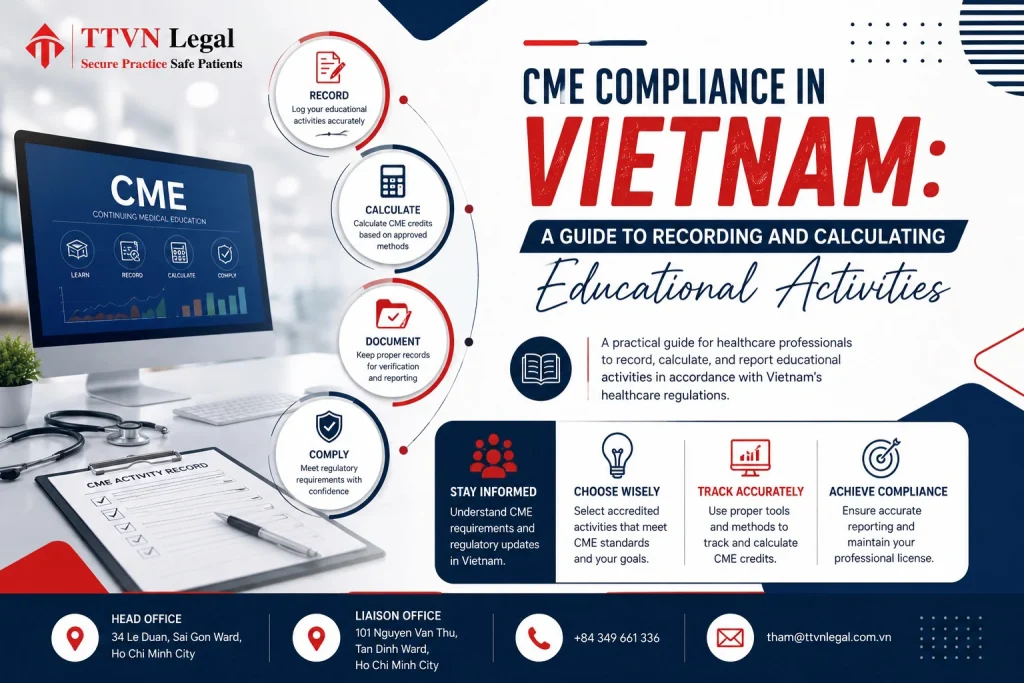
The maintenance of complete CME compliance in the Socialist Republic of Vietnam is dependent on the establishment of rigorous, transparent record-keeping systems. Under the Law on Medical Examination and Treatment 2023, the state places the full burden of proof regarding educational tracking on individual practitioners and their employing institutions. The underlying legal philosophy is that compliance cannot be assumed or verified verbally; it must be supported by an organized, continuous paper trail that details every step of the professional development path. Accurate recording is treated as a core element of clinical governance, essential to demonstrate institutional transparency and protect active operations from regulatory intervention.
2. The Regulatory Framework
The statutory rules governing record-keeping are strictly enforced under the provisions of Decree No. 96/2023/ND-CP and Circular No. 32/2023/TT-BYT. State regulators, operating through provincial Departments of Health (DOH), carry a jurisdictional mandate to execute routine and unannounced administrative inspections of all medical facilities nationwide. During these inspections, state officers check the physical and digital archives of the institution, verifying that all active clinical personnel maintain up-to-date, compliant training records that match the official registries of accredited training providers.
3. Detailed Compliance Checklists for Medical Institutions
To manage this administrative burden successfully and ensure that the facility is always audit-ready, clinic compliance managers must utilize the following recording framework:
Centralized Digital Archive Architecture: Private clinics must implement secure internal databases specifically designed to store high-resolution digital copies of all staff CME certificates.
Meticulous Tracking Log Maintenance: Every entry in the internal compliance matrix must clearly detail the exact date of training, the specific accredited provider, the precise credit hours earned, and the scheduled expiration date of the practitioner’s current 5-year compliance window.
Quarterly Portfolio Discrepancy Screening: Compliance checkers must run systemic internal audits every quarter to identify any clinical personnel who are falling behind their annualized training milestones.
4. Enforcement Mechanisms, Penalties, and Managing Corporate Liability
The enforcement mechanisms under current healthcare administrative law apply immediate and severe penalties to any facility found in default during an unannounced inspection. If an inspector discovers a practitioner operating with incomplete training hours or invalid certificates, the medical establishment faces immediate administrative fines, potential temporary closure of specialized clinics, and significant reputational damage within the market.
To eliminate these corporate liabilities, medical operators must move away from reactive administrative habits and instead treat record-keeping as a central operational priority. Implementing rigorous internal tracking logs ensures that clinics can withstand unannounced state inspections smoothly, protecting active operating licenses and demonstrating a high commitment to regulatory compliance.
Conclusion
In conclusion, robust data storage and detailed record-keeping form the foundation of successful corporate CME compliance management in Vietnam. Implementing comprehensive internal tracking matrices allows healthcare institutions to eliminate regulatory exposure, protect active clinic operations, and secure long-term operational success.
Need expert legal support for healthcare investment in Vietnam? TTVN Legal | 101 Nguyen Van Thu, Tan Dinh Ward, Ho Chi Minh City, Vietnam +84 349661336 | tham@ttvnlegal.com.vn | https://ttvnlegal.com.vn/