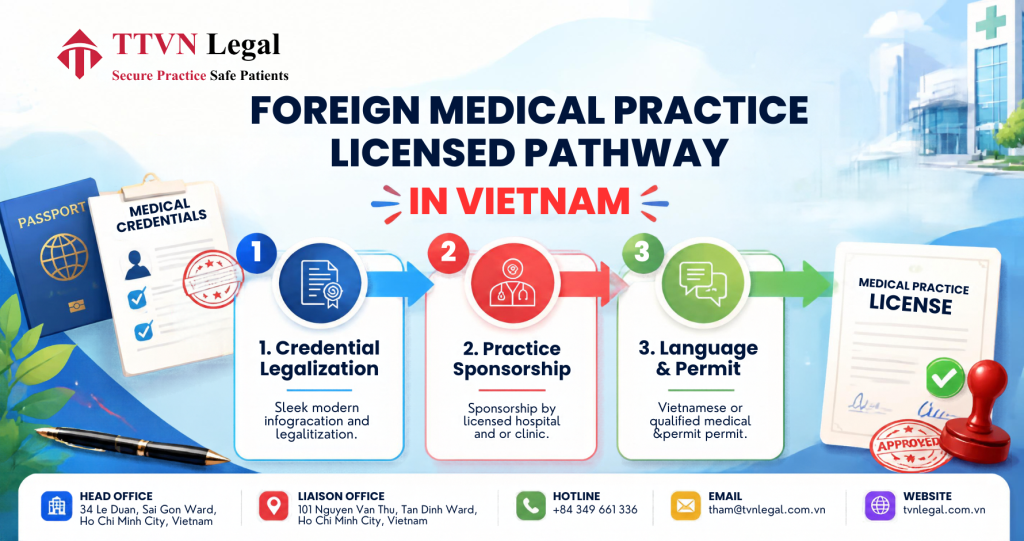
Foreign medical graduates who wish to practise medicine in Vietnam must satisfy a number of legal and professional requirements before obtaining a Vietnamese Medical Practice License. Based on the current regulations, this article outlines the key steps in the licensing pathway, from recognition of the foreign medical qualification and practical training in Vietnam to professional competency assessment, issuance of the Medical Practice License, continuing medical education, and subsequent renewal of the licence.
1. Recognition of the Foreign Medical Diploma in Vietnam
The first step is to have the foreign medical diploma recognized in accordance with Vietnamese regulations.
A foreign medical degree alone does not automatically allow its holder to practise medicine in Vietnam. The qualification must satisfy the applicable Vietnamese requirements for professional qualifications and, where required, be formally recognized by the competent Vietnamese authority.
This step is particularly important for foreign medical graduates who do not hold a medical practice licence issued by their home country.
2. Complete Practical Training in a Vietnamese Hospital
After the foreign medical qualification has been appropriately recognized, the applicant generally needs to complete the statutory practical training required for a Vietnamese Medical Practice License.
For doctors, the practical training period is generally 12 months, consisting of:
9 months of professional medical examination and treatment practice; and
3 months of emergency resuscitation practice.
The practical training must be carried out at an appropriate medical examination and treatment establishment and under the required supervision.
For foreign medical graduates, this stage is often described as undertaking a medical internship in Vietnam. However, “practical training” is the more appropriate legal terminology.
3. Language and Interpreter Arrangements During Practical Training
A foreign medical graduate may, subject to the applicable requirements, undertake professional activities using English with an appropriate interpreter where the applicant does not meet the required Vietnamese language standard.
The interpreter arrangement must comply with Vietnamese regulations, including the requirements concerning the interpreter’s qualifications and the relevant employment or engagement arrangement.
At the same time, the foreign applicant should prepare to satisfy the Vietnamese-language requirements applicable to medical examination and treatment.
4. Take the Vietnamese Language Test for Medical Examination and Treatment
The applicant may need to demonstrate the required level of Vietnamese proficiency for medical examination and treatment.
Accordingly, learning Vietnamese specifically for medical examination and treatment should be treated as a separate stage of the licensing preparation process.
This is particularly important because the professional competency assessment process is currently being prepared and conducted in Vietnamese.
5. Take the Professional Competency Assessment
Following completion of the required practical training, the applicant must satisfy the applicable professional competency assessment requirements.
For doctors, the competency assessment system is being implemented nationally, with mandatory application becoming relevant from 2027.
At present, the examination is prepared in Vietnamese. Therefore, foreign medical graduates should consider Vietnamese-language preparation an essential part of their licensing strategy, rather than relying solely on an interpreter.
6. Apply for the Vietnamese Medical Practice License
Once the applicant has completed the required qualification recognition, practical training, language and competency requirements, the next step is to prepare and submit the application dossier for issuance of the Vietnamese Medical Practice License.
The dossier may include, among other documents:
recognized professional qualification;
health certificate;
evidence of completion of practical training;
competency assessment results, where applicable;
Vietnamese-language qualification or qualifying interpreter documentation, where applicable; and
other documents required under Vietnamese regulations.
The exact documentation should be reviewed based on the applicant’s nationality, qualification, professional title, language ability and individual circumstances.
7. Maintain the License Through Continuing Medical Education
Obtaining the Medical Practice License is not the end of the regulatory process. Practitioners are required to maintain their professional competence through continuing medical education (CME) and accumulation of the required professional development credits.
For the applicable licensing cycle, the practitioner should plan to obtain the required 120 CME credits and maintain appropriate evidence of completion.
8. Renew the Vietnamese Medical Practice License
A Vietnamese Medical Practice License has a limited validity period of 5 years. Accordingly, the practitioner must complete the applicable continuing professional development requirements and prepare for renewal of the Medical Practice License before its expiry.
The renewal process should therefore be considered from the beginning of the licensing cycle, rather than only when the licence is about to expire.
Conclusion
For a foreign medical graduate who does not hold a foreign medical practice licence, the practical pathway can generally be summarized as follows:
Recognition of Foreign Medical Diploma
↓
12-Month Practical Training in Vietnam
↓
English + Qualified Interpreter Arrangement, where applicable
↓
Vietnamese Language Preparation / Assessment
↓
Professional Competency Assessment
↓
Application for Vietnamese Medical Practice License
↓
120 CME Credits
↓
Renewal of Vietnamese Medical Practice License
The precise requirements may vary depending on the applicant’s foreign qualification, professional title, nationality, language ability, previous professional experience and the timing of the application. A case-specific review is therefore recommended before the applicant begins the practical-training stage.
Note: This article is provided for informational purposes only. The views and interpretations expressed herein represent those of TTVN Legal at the time of publication and are subject to change without prior notice.