1. Introduction
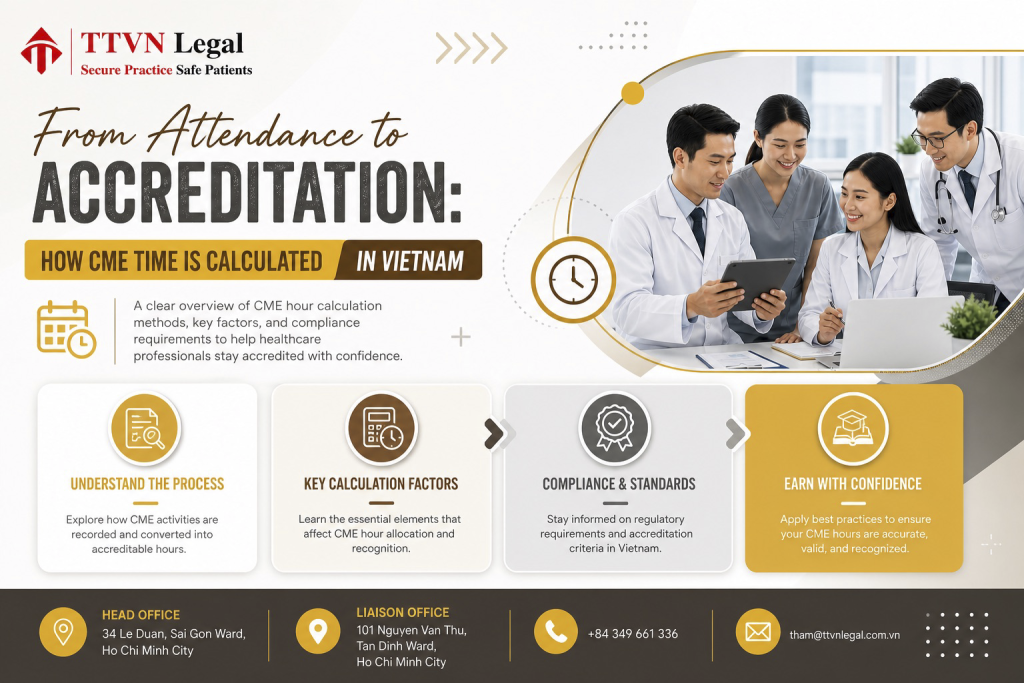
The transition from simply attending a medical seminar to securing legally recognized continuing education credits in the Socialist Republic of Vietnam is governed by a strict, multi-step validation process. Under the Law on Medical Examination and Treatment 2023, physical presence at an educational event does not automatically guarantee statutory compliance. The underlying legal philosophy is that educational time must undergo direct institutional verification before it can be used to protect a practitioner’s active license. This rigorous system is designed to eliminate low-quality, unverified training programs and ensure that every credit hour logged represents a structured, pre-approved educational advancement aligned with national clinical standards.
2. The Regulatory Framework
The administrative workflow for converting attendance into formal accreditation is strictly managed under the training frameworks enforced by the Ministry of Health (MOH) and local Departments of Health (DOH). First, the training host must submit the detailed course curriculum, speaker profiles, and instructional hours to the state for official pre-approval, securing a formal tracking number. Following the conclusion of the program, the accredited provider must enter participant data directly into the state registry and issue a standardized certificate that explicitly states the verified attendance hours, cross-referencing the participant’s unique medical practice license number.
3. Detailed Compliance Checklists for Medical Institutions
To navigate this official validation workflow successfully and prevent administrative verification delays during license reviews, clinic managers must execute the following protocols:
Pre-Course Approval Verification: Compliance teams must confirm that the selected training course has secured a formal tracking number from the Ministry of Health before authorizing staff attendance.
Data Accuracy Inspection: Human resource departments must carefully check that the practitioner’s name, unique practice license number, and national ID are entered correctly into the host institution’s post-course database.
Standard Certificate Collection: Monitoring teams must ensure that every collected certificate explicitly states the verified attendance hours and displays the official institutional seal of the accredited provider.
4. Enforcement Mechanisms, Penalties, and Managing Corporate Liability
The enforcement mechanisms under current healthcare administrative guidelines provide zero flexibility for incomplete or poorly drafted documentation. Any spelling errors, missing tracking numbers, or unverified hours on a submitted certificate can lead to immediate regulatory rejections by the reviewing Department of Health, forcing the practitioner to undergo lengthy manual appeals and creating a critical compliance gap in their multi-year training record.
For corporate healthcare providers, managing these administrative risks is essential to protect clinical continuity. Ensuring that all educational activities follow the official validation workflow step-by-step allows institutions to mitigate licensing liabilities, avoid sudden staffing shortages, and secure absolute regulatory alignment during routine or unannounced state audits.
Conclusion
In conclusion, a clear understanding of how educational time converts into formal statutory accreditation is crucial for every clinician and medical manager in Vietnam. Navigating the validation workflow step-by-step eliminates administrative friction and prevents unnecessary license renewal delays.
Need expert legal support for healthcare investment in Vietnam? TTVN Legal | 101 Nguyen Van Thu, Tan Dinh Ward, Ho Chi Minh City, Vietnam +84 349661336 | tham@ttvnlegal.com.vn | https://ttvnlegal.com.vn/