
1. Introduction
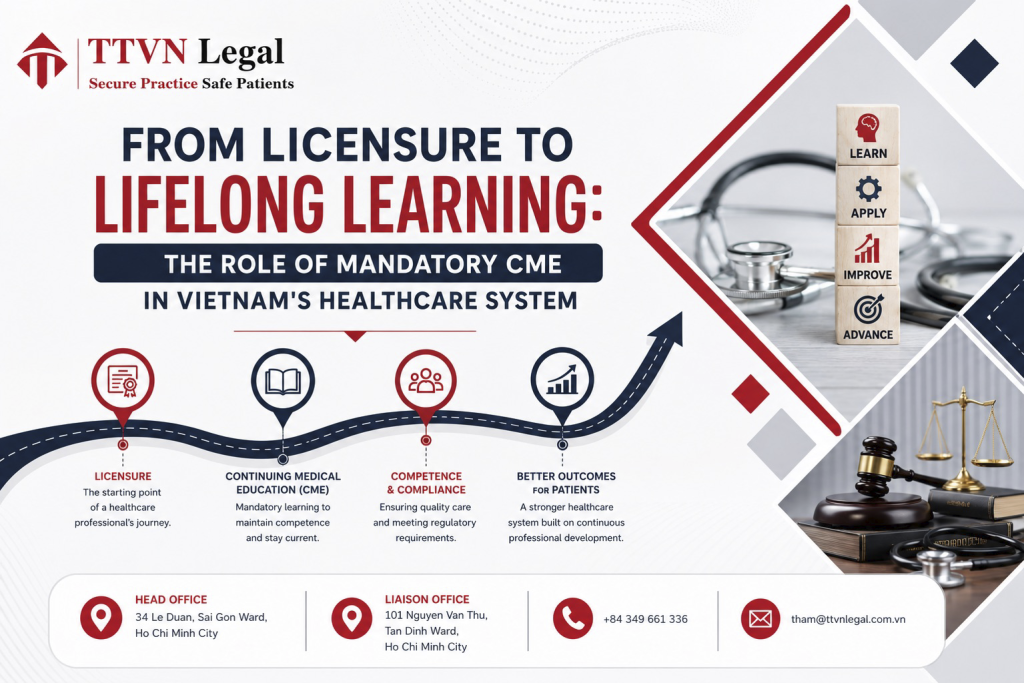
The implementation of the Law on Medical Examination and Treatment 2023 fundamentally reshapes the professional lifecycle of healthcare practitioners in Vietnam. Under the historic, legacy legal frameworks, a medical practice certificate was treated as a static credential, granted permanently upon entry into the profession with minimal ongoing verification of technical skills or clinical safety. The current statutory regime completely dismantles this outdated model, replacing it with a dynamic system where licensure is explicitly tied to verified proof of continuous professional development. The core legal philosophy driving this transition is that medical competence is perishable, and therefore, the legal right to practice medicine must be continuously renewed through structured lifelong learning.
2. The Regulatory Framework
This paradigm shift places clear jurisdictional mandates on all clinical personnel and corporate healthcare operators across the nation. Guided by the regulatory provisions of Circular No. 32/2023/TT-BYT, the state uses mandatory CME as its primary tool for modernizing clinical governance and ensuring public safety. Provincial Departments of Health (DOH) are empowered to strictly audit training portfolios, turning what was once a minor administrative detail into a central pillar of licensing defense. For private international hospital groups and localized specialty clinics alike, this requires a complete re-engineering of operational models, as maintaining valid practicing certificates now demands continuous institutional oversight and structured educational planning.
3. Detailed Compliance Checklists for Medical Institutions
To embed the principles of lifelong learning into daily operations while securing complete statutory compliance, medical institutions must utilize the following framework:
Mandatory Credential Synchronization: Compliance teams must align individual physician employment contracts with their specific 5-year rolling CME calendars, ensuring that training progress is audited systematically during annual performance reviews.
Evidence-Based Protocol Integration: Clinical directors should ensure that the advanced methodologies acquired by medical staff during accredited CME courses are actively integrated into the facility’s internal standard operating procedures (SOPs).
Cross-Disciplinary Training Metrics: Educational plans must be diversified to ensure that clinical personnel accumulate credit hours across technical specialties, patient safety protocols, and medical ethics, reflecting a comprehensive approach to professional development.
4. Enforcement Mechanisms, Penalties, and Managing Corporate Liability
The enforcement mechanisms under current administrative law leave no room for non-compliance. If an individual physician fails to document 120 verified credit hours at the conclusion of their 5-year regulatory window, their active practicing certificate will face immediate administrative suspension. Operating a medical facility with non-compliant personnel triggers severe corporate liabilities under Decree No. 96/2023/ND-CP, including heavy financial penalties, potential public closure of specific departments, and significant reputational fallout within a highly competitive healthcare market.
To eliminate these corporate liabilities, medical operators must establish strict internal clinical governance systems. Treating mandatory CME not as an occasional bureaucratic hurdle but as an essential element of professional licensure defense allows institutions to safeguard their operations, protect patient safety, and maintain a highly qualified, legally bulletproof medical workforce.
Conclusion
In conclusion, the transition from static licensure to mandatory lifelong learning marks a vital step forward for Vietnam’s healthcare ecosystem. Active compliance with CME regulations is an essential operational requirement to maintain clinical governance, guarantee patient safety, and secure corporate legal standing in the private medical sector.
Need expert legal support for healthcare investment in Vietnam? TTVN Legal | 101 Nguyen Van Thu, Tan Dinh Ward, Ho Chi Minh City, Vietnam +84 349661336 | tham@ttvnlegal.com.vn | https://ttvnlegal.com.vn/