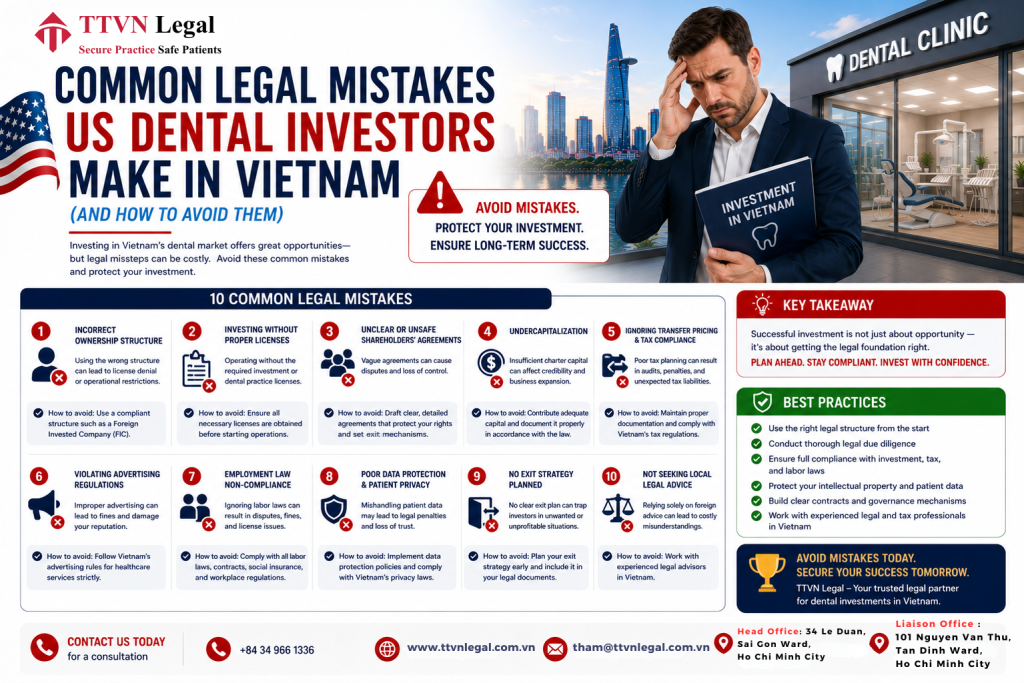
Vietnam’s dental investment market continues to attract significant US interest, but the journey from investment decision to profitable clinic operation is littered with legal pitfalls. Many of these pitfalls are entirely avoidable with proper preparation and expert guidance—yet they appear repeatedly across US-invested dental operations.
This guide identifies the most common legal mistakes made by US dental investors in Vietnam and provides actionable advice on how each can be avoided.
Mistake 1: Relying on Generic Business Lawyers Instead of Healthcare Specialists
Vietnam has a well-developed legal profession, and many international law firms offer M&A and investment services. However, dental clinic establishment involves healthcare-specific regulatory requirements—operating license conditions, practitioner licensing, infection control, radiation safety, and advertising regulations—that general commercial lawyers may not be familiar with.
US investors who rely on general corporate lawyers to manage the clinic licensing process frequently encounter:
Incomplete dossiers that are rejected by the Department of Health;
Incorrect facility design that fails the operating license inspection;
Overlooked supporting permits (radiation safety, fire safety) that delay opening;
Advertising campaigns launched without required MOH approval.
Avoidance: Engage a Vietnamese law firm with demonstrated healthcare regulatory expertise—specifically in dental or medical clinic licensing under Decree 96/2023/ND-CP—from the very beginning of the project.
Mistake 2: Underestimating the Responsible Director Licensing Timeline
The responsible clinical director’s Vietnamese dental practice license is almost always the critical path item in dental clinic setup. US investors frequently proceed with facility construction and company registration before confirming that a qualified responsible director with a Vietnamese license will be available when the clinic is ready to open.
If the intended responsible director (whether a US dentist or a recruited Vietnamese dentist) does not have their license by the time the facility is complete and all other permits are in hand, the operating license application cannot be filed—and the facility sits idle, accumulating rent and overhead costs.
Avoidance: Identify and begin the licensing process for the responsible director as the very first step in the clinic setup project. If the director is a US dentist, initiate the MOH recognition process at least 12 months before the intended opening date. If a locally licensed Vietnamese director is being recruited, confirm license validity and availability before any other setup step.
Mistake 3: Incorrect Structuring of the Investment Entity
US dental investors sometimes structure their Vietnamese investment in ways that create complications later:
Registering the company in a province different from where the clinic will operate: This requires the operating license to be issued by the provincial Department of Health at the clinic’s location, while the company is registered elsewhere—creating administrative complexity.
Using an individual’s name rather than a corporate entity: While individuals can invest in Vietnam, using a properly structured corporate entity (LLC) typically provides better liability protection, governance clarity, and exit flexibility.
Registering an incorrect business scope: Failing to include dental examination and treatment services in the IRC and ERC business lines means the company technically cannot apply for the healthcare operating license.
Avoidance: Have a Vietnamese healthcare investment lawyer review and advise on the optimal corporate structure before filing any investment registration application.
Mistake 4: Signing a Lease Without a Healthcare Use Clause
The property lease for a dental clinic must explicitly permit use of the premises for healthcare activities. Many commercial property leases in Vietnam do not include this provision as a default—they permit general commercial use but not specifically healthcare or dental clinic use.
If the lease does not permit healthcare use, the landlord can legally refuse to consent to the clinic’s registration at that address, making it impossible to obtain an operating license for those premises.
Avoidance: Before signing any lease for a dental clinic location, have the lease reviewed by a Vietnamese lawyer to confirm it permits healthcare use, allows for the structural modifications required by Decree 96/2023/ND-CP, and grants the necessary right to register the healthcare facility at that address.
Mistake 5: Overlooking Ongoing Compliance Obligations
Many US dental investors treat compliance as a one-time hurdle to overcome at clinic opening, rather than an ongoing operational obligation. After the operating license is issued, the following ongoing obligations must be actively managed:
Annual reporting to the provincial Department of Health on clinic operations;
License renewal before expiry of the operating license, work permits, and individual practice licenses;
Radiation safety permit renewal;
Fire safety certificate renewal;
Social insurance contribution compliance;
Advertising content approval for new campaigns;
License amendment applications whenever the service scope, responsible director, or clinic address changes.
Avoidance: Implement a compliance calendar managed by a designated compliance officer or external legal advisor. Set reminders for every key expiry date at least 90 days in advance.
Mistake 6: Neglecting Vietnamese Employment Law from Day One
US dental investors who focus intensely on the healthcare licensing process sometimes pay insufficient attention to Vietnamese employment law—and then face labor disputes, social insurance audits, or work permit violations that create serious operational disruption.
Common employment law mistakes:
Allowing employees to start work without signed employment contracts;
Failing to enroll employees in social insurance from month one;
Permitting foreign dental staff to practice before their work permits are issued;
Setting social insurance base salaries below actual compensation;
Not maintaining proper HR records for all staff.
Avoidance: Engage a Vietnamese HR consultant or labor lawyer to set up compliant employment processes before hiring the first employee. Treat labor compliance with the same rigor as healthcare licensing compliance from the very beginning of operations.
Conclusion
The most common legal mistakes by US dental investors in Vietnam are avoidable with proper planning, specialist legal advice, and disciplined compliance management. The rewards of successful dental clinic investment in Vietnam are significant, but only for investors who build their operations on a solid legal foundation. TTVN Legal provides specialist healthcare investment legal services to US dental investors, from initial feasibility through to compliant, profitable clinic operation.
Need expert legal support for healthcare investment in Vietnam? TTVN Legal | 101 Nguyen Van Thu, Tan Dinh Ward, Ho Chi Minh City, Vietnam +84 349661336 | tham@ttvnlegal.com.vn | https://ttvnlegal.com.vn/