Every investment requires an exit, and dental clinic investors in Vietnam are increasingly focused on how they will eventually realize the value of their investment. For Canadian investors, the exit options are shaped by Vietnamese foreign investment law, the transferability of healthcare operating licenses, and the tax treatment of capital gains.
This guide explains the principal exit options available to Canadian dental clinic investors in Vietnam and the legal considerations associated with each.
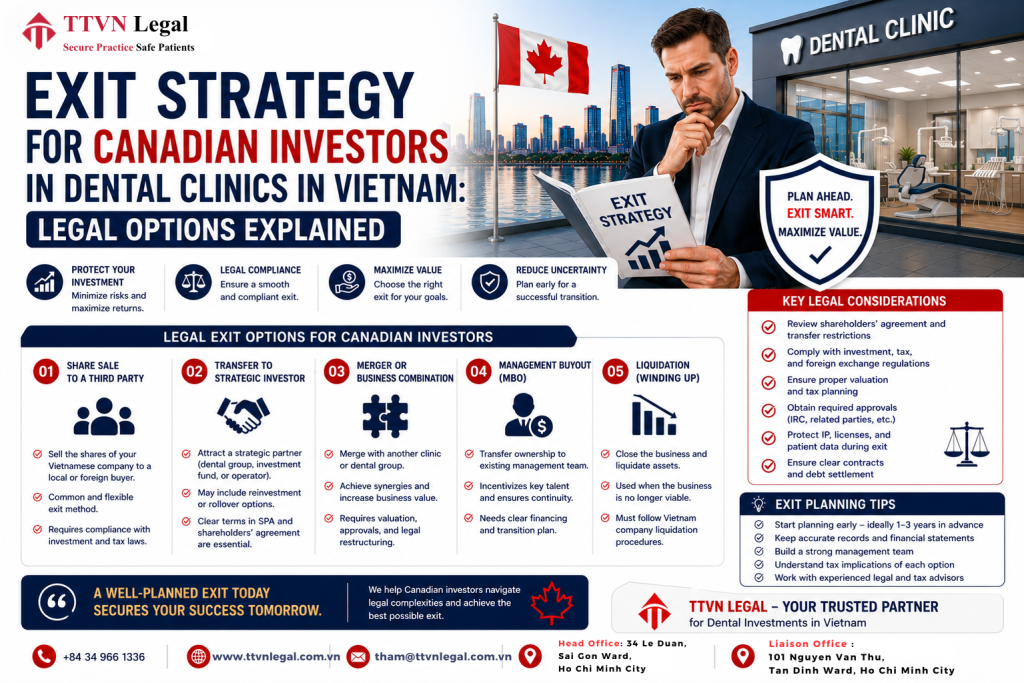
Exit Option 1: Trade Sale (Sale of Shares to a Third Party)
The most common exit route for successful dental clinic investors in Vietnam is a trade sale—selling shares in the Vietnamese dental clinic entity to a third-party buyer (strategic investor, private equity, or another dental group).
Key legal considerations:
IRC amendment: If the buyer is a foreign investor acquiring 51%+ of the entity, the acquisition requires an IRC amendment from the provincial DPI. This adds regulatory processing time to the transaction timeline.
Operating license continuity: In a share sale, the operating license remains with the entity and generally survives the change of ownership. However, any change in the responsible clinical director must be reported to the Department of Health.
Share transfer tax: The Vietnamese seller (Canadian investor) is subject to a 20% capital gains tax on the profit from the share sale. This must be withheld by the buyer (or self-reported by the seller) and remitted to the Vietnamese tax authority.
JV agreement restrictions: If the Canadian investor holds shares through a JV, the JV agreement’s right-of-first-refusal and transfer restriction provisions must be complied with before shares can be sold to a third party.
Exit Option 2: Sale of Assets (Clinic Business Transfer)
In an asset sale, the Canadian investor sells the physical and operational assets of the dental clinic (equipment, lease rights, patient database, brand, goodwill) rather than shares in the company. The buyer acquires the business as a going concern but without the corporate entity.
Key implications:
Operating license does not transfer: The buyer must apply for a new operating license for the same premises. This is a significant complication that typically reduces the attractiveness of asset sales for dental clinic acquisitions.
Tax treatment: The gain from sale of business assets is treated as income of the Vietnamese entity, subject to CIT at 20%.
Lease assignment: The property lease must be assignable to the buyer; landlord consent is typically required.
Asset sales are less common in dental clinic M&A in Vietnam due to the operating license complication but may be appropriate where the corporate entity carries significant liabilities that the buyer does not wish to assume.
Exit Option 3: Liquidation
If the dental clinic is not commercially successful or the investor simply wishes to wind down operations, the entity can be voluntarily liquidated. Liquidation of a foreign-invested healthcare entity in Vietnam involves:
Resolution to dissolve by the owners;
Notification to the provincial DPI and relevant regulatory authorities;
Surrender of the healthcare operating license to the Department of Health;
Settlement of all outstanding obligations (employee entitlements, taxes, social insurance, supplier debts);
Deregistration of the enterprise with the DPI;
Repatriation of remaining capital (after all obligations are settled) to the Canadian investor.
Liquidation can take 6–18 months depending on the complexity of outstanding obligations and the efficiency of the regulatory deregistration process.
Exit Option 4: IPO or Strategic Partnership with a Listed Entity
For larger Canadian dental investors with multiple locations or a well-established brand, a partial exit through investment by a listed Vietnamese company or strategic healthcare group is an emerging option in Vietnam’s growing private equity and healthcare consolidation market.
This route is complex and requires:
Restructuring of the corporate entity to make it investable (clean corporate governance, audited financial statements, transfer pricing compliance);
Negotiation of investor rights, governance provisions, and exit mechanisms in a comprehensive shareholders’ agreement;
Regulatory compliance with Vietnamese securities law if a public company investment is involved.
Canadian investors planning this exit route should begin compliance preparation 2–3 years before the intended exit to ensure the business is investor-ready.
Tax Planning for Exit
The tax consequences of exit are a critical planning consideration:
Share sale: 20% capital gains tax on the net gain (sale price minus cost basis). Tax is calculated per the transaction price or (if the tax authority considers the price not at arm’s length) at a price assessed by the tax authority.
Asset sale: Subject to CIT on the gain (20%) at the entity level.
Liquidation: Capital returned to investors after all tax obligations are settled; repatriation of profits is subject to annual PIT finalization.
Pre-exit dividends: Extracting accumulated profits as dividends before exit is currently not subject to Vietnamese withholding tax for dividends paid to foreign corporate shareholders—a legitimate pre-exit tax planning tool.
Canadian investors should model the after-tax net proceeds of each exit option with both Vietnamese and Canadian tax advisors to determine the optimal approach.
Preparing the Clinic for Exit: Value Maximization
The value realized at exit is directly related to the clinic’s compliance and operational quality at the time of sale. Canadian investors should:
Maintain impeccable regulatory compliance (valid operating license, current practitioner licenses, up-to-date permits) to maximize buyer confidence;
Build a strong, documented patient database (a key revenue asset);
Ensure clean, audited financial statements for at least 3 years prior to exit;
Resolve any outstanding labor disputes or regulatory compliance issues before marketing the business;
Invest in physical assets (equipment upgrades, facility improvements) in the years before exit to maximize the appraisal value;
Document all operational SOPs to demonstrate that the business operates independently of any single individual.
Conclusion
Canadian dental clinic investors in Vietnam have multiple exit pathways, each with distinct legal, tax, and operational implications. Trade sales (share sales) are generally the most commercially attractive route, but require careful regulatory management and tax planning. TTVN Legal advises Canadian dental investors on exit strategy structuring, M&A transaction management, and post-exit regulatory compliance.
Need expert legal support for healthcare investment in Vietnam? TTVN Legal | 101 Nguyen Van Thu, Tan Dinh Ward, Ho Chi Minh City, Vietnam +84 349661336 | tham@ttvnlegal.com.vn | https://ttvnlegal.com.vn/