Mergers and acquisitions (M&A) in Vietnam’s dental sector have increased significantly as the market matures and early investors seek exit opportunities. For Australian dental investors considering acquisition of an existing dental clinic or dental group in Vietnam, rigorous legal due diligence is the most important risk management tool available.
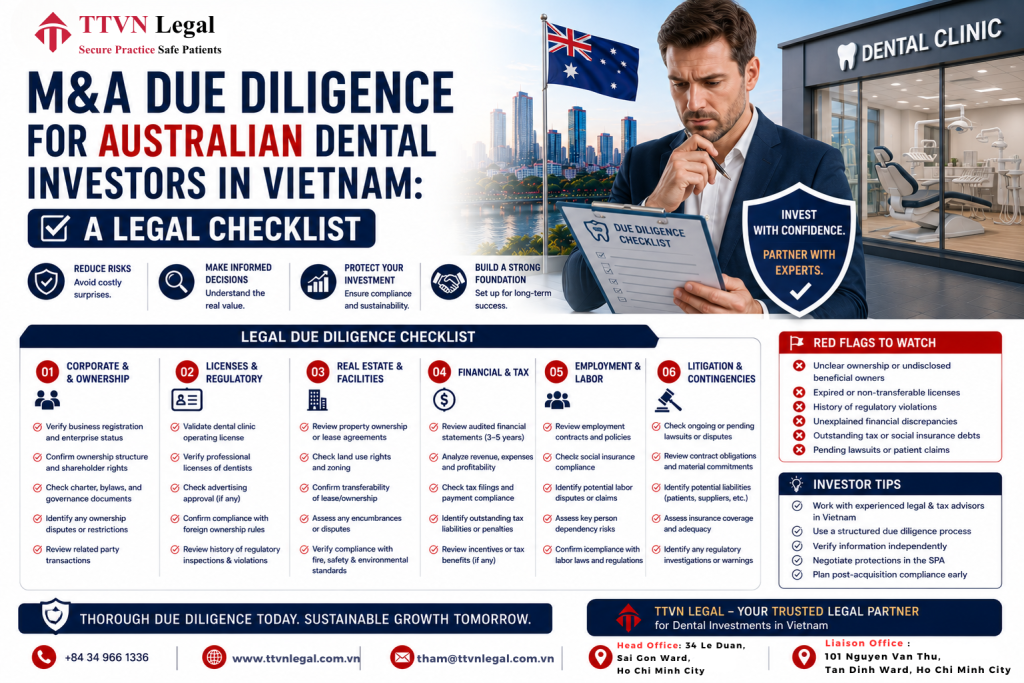
This guide provides a comprehensive M&A due diligence framework specifically tailored for Australian investors acquiring dental clinics in Vietnam, covering corporate, regulatory, labor, financial, and operational due diligence streams.
Corporate and Ownership Due Diligence
The foundation of M&A due diligence is verifying that the seller actually owns what they claim to own:
Confirm the corporate structure: Identify all shareholders, ownership percentages, and any encumbrances (pledges, charges, or third-party claims on shares);
Review the Investment Registration Certificate (IRC): Confirm it is valid, reflects the current ownership structure, and includes dental clinic services in the permitted business scope;
Review the Enterprise Registration Certificate (ERC): Confirm the current registered capital, legal representative, and business address;
Check for any shareholder agreements or related-party arrangements affecting ownership or management rights;
Verify that all previous capital contributions have been made as required.
For Australian investors acquiring shares, any existing shareholder agreement or JV agreement must be reviewed in detail, as these may contain anti-transfer clauses, right-of-first-refusal provisions, or change-of-control triggers.
Healthcare License Due Diligence
Healthcare licensing due diligence is the most critical stream for dental clinic acquisitions:
Operating license: Obtain and review the current operating license. Confirm it is valid (not expired, suspended, or under administrative review), reflects the current clinic address and service scope, and names the current responsible clinical director.
License history: Review all amendments to the operating license since issuance. Identify any reductions in scope, changes of responsible director, or compliance conditions imposed by the Department of Health.
Responsible director: Verify the responsible director’s Vietnamese dental practice license is valid and their scope of practice covers all services currently offered by the clinic.
Other practitioner licenses: Verify the validity of all dentists’ individual practice licenses. Identify any expired or suspended licenses.
Compliance history: Review any MOH or Department of Health inspection reports, warnings, or sanctions in the past 3 years.
Labor and Employment Due Diligence
Labor liabilities are a common source of post-acquisition disputes for Australian investors:
Review all employment contracts: Confirm contracts are compliant with the Labor Code 2019; identify any oral employment arrangements that should be formalized.
Social insurance records: Obtain social insurance payment records for the past 3 years; confirm all employees are enrolled and contributions are current. Social insurance arrears transfer with the business in a share acquisition.
Work permit compliance: Verify all foreign employees hold valid work permits for their current positions at the clinic.
Outstanding labor disputes: Identify any pending labor conciliation, arbitration, or court proceedings.
Remuneration and benefits: Review the salary structure for all employees; identify any informal compensation arrangements not reflected in contracts.
Key person risk: Assess the likelihood that key staff (responsible director, senior dentists) will remain after the acquisition. Consider retention arrangements as part of the transaction structure.
Financial and Tax Due Diligence
Financial due diligence for dental clinic acquisitions should cover:
Revenue and patient volume: Cross-reference revenue records with patient appointment logs, clinical records, and tax invoices to verify revenue integrity.
Tax compliance: Obtain tax authority clearance certificates for the past 3 years; review CIT finalization reports; identify any outstanding tax assessments or audit notices.
VAT compliance: Review the VAT treatment of dental services; identify any risk of VAT reclassification of cosmetic services.
Transfer pricing: If the target has related-party transactions, review transfer pricing documentation.
Accounts receivable: Assess the quality and collectability of outstanding patient accounts receivable.
Liabilities: Identify all outstanding liabilities, including trade payables, bank loans, intercompany debt, and contingent liabilities.
Operational and Physical Asset Due Diligence
Operational due diligence confirms the physical assets supporting the business:
Premises: Review the property lease agreement; confirm remaining term, renewal options, permitted use for dental clinic operations, and transferability on a change of control.
Equipment: Obtain an equipment inventory; verify condition, age, and maintenance records; confirm radiation safety permits for X-ray equipment are current.
IT systems: Assess the clinic management software, patient records system, and data security arrangements.
Supplier contracts: Review contracts with dental material suppliers, sterilization service providers, and maintenance companies.
Patient database: Assess the completeness and transferability of patient records, subject to data privacy compliance.
Regulatory Approval Requirements for the Acquisition
Australian investors completing a share acquisition in a Vietnamese dental clinic must also navigate post-signing regulatory steps:
IRC amendment: If the acquisition results in a foreign investor holding 51%+ of the entity, or if any threshold that triggers IRC amendment is crossed, approval from the Department of Planning and Investment is required before or concurrent with completion.
Operating license amendment: Changes in ownership may trigger a reporting obligation to the Department of Health and potentially a license amendment if the responsible director or registered owner changes.
Share transfer tax: Capital gains on the seller’s shares are subject to Vietnamese tax (typically 20% on the gain), withheld by the acquiring party. Confirm this has been properly addressed in the transaction documents.
Conclusion
M&A due diligence for Australian dental investors in Vietnam requires a specialized multi-stream approach covering healthcare licensing, labor compliance, tax, corporate structure, and physical assets. Incomplete or generic due diligence frequently leads to post-acquisition liability surprises. TTVN Legal provides comprehensive healthcare-specific M&A due diligence services for Australian dental investors, ensuring every risk is identified before completion.
Need expert legal support for healthcare investment in Vietnam? TTVN Legal | 101 Nguyen Van Thu, Tan Dinh Ward, Ho Chi Minh City, Vietnam +84 349661336 | tham@ttvnlegal.com.vn | https://ttvnlegal.com.vn/