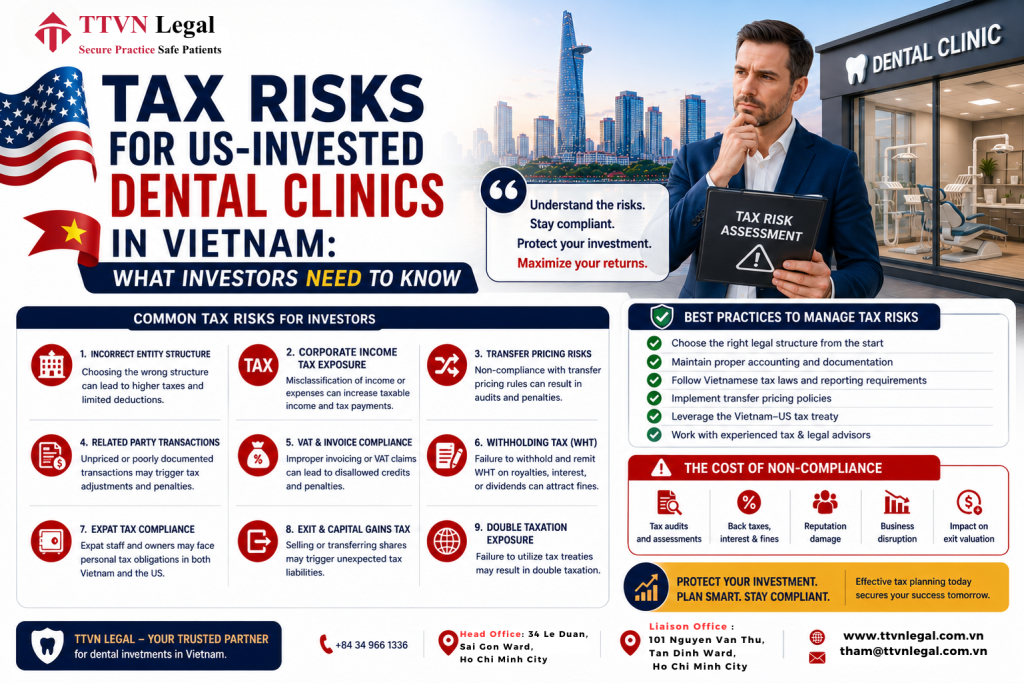
Vietnam’s tax environment for foreign-invested enterprises involves several risk areas that US dental investors frequently underestimate. From incorrect VAT treatment of dental services to transfer pricing exposure for intercompany arrangements, tax risks can result in significant back-tax assessments, penalties, and reputational harm.
This guide identifies the principal tax risks for US-invested dental clinics in Vietnam and explains how to manage them effectively.
Tax Risk 1: Incorrect VAT Classification of Dental Services
Vietnamese VAT law distinguishes between medical services (VAT-exempt) and non-medical cosmetic services (subject to VAT at 5% or 10%). For dental clinics, this distinction is commercially and legally important:
Therapeutic dental services (examination, fillings, root canal treatment, extractions, prosthetics for medical necessity): VAT-exempt.
Purely cosmetic dental services (teeth whitening for aesthetic purposes, purely elective veneers): May be subject to VAT.
Many US dental clinics in Vietnam apply blanket VAT exemption to all services without distinguishing cosmetic from therapeutic treatments. If the tax authority reclassifies cosmetic revenue as VATable during an audit, the clinic faces a back-assessment of output VAT plus a 20% late penalty and interest.
Mitigation: Obtain a formal VAT classification opinion from a Vietnamese tax advisor before opening, and maintain clear clinical records distinguishing therapeutic from purely aesthetic treatments.
Tax Risk 2: Transfer Pricing Exposure
US dental clinic groups that structure intercompany arrangements between their Vietnamese entity and US parent or related companies face transfer pricing risk. Common intercompany arrangements that trigger transfer pricing rules under Decree 132/2020/ND-CP include:
Management fees paid to a US parent company;
Technology licensing fees or software subscription charges;
Intercompany loans;
Shared services arrangements.
All such arrangements must be priced at arm’s length, documented in a contemporaneous transfer pricing study, and disclosed in the annual CIT return. Failure to comply can result in the tax authority disallowing the deduction for intercompany expenses, leading to higher taxable income and potential penalties.
Mitigation: Engage a Big 4 or reputable Vietnamese tax firm to prepare an annual transfer pricing documentation file before the CIT finalization deadline.
Tax Risk 3: Incorrect PIT Withholding for Expatriate Staff
US dental clinics employing foreign dentists (including US citizens) frequently make errors in personal income tax withholding:
Applying the non-resident flat rate (20%) to employees who have become Vietnamese tax residents (183+ days per calendar year) and should be taxed at progressive rates;
Failing to include non-cash benefits (housing allowances, school fees, health insurance premiums paid by the employer) in the taxable income base;
Missing the annual PIT finalization deadline (March 31 of the following year), resulting in penalties;
Not correctly applying dependent deductions for employees’ declared dependents.
Mitigation: Conduct an annual payroll review at the start of each calendar year, reassess each expatriate employee’s residency status, and confirm that all taxable benefits are included in the withholding calculation.
Tax Risk 4: Under-Reporting of Revenue
Vietnam’s tax authorities use industry benchmarking to assess whether a dental clinic’s reported revenue is plausible given its location, staffing, and patient volume. Revenue that appears significantly below industry norms triggers audit attention.
US dental clinics that:
Issue mixed cash and invoice payments to patients;
Do not maintain complete electronic patient revenue records;
Have revenue gaps between their accounting system and MOH-reported patient volume statistics;
…face risk of revenue under-reporting assessments with penalties of up to 3 times the tax deficiency.
Mitigation: Implement a clinic management system that generates VAT-compliant tax invoices for all billable services, maintains complete patient billing records, and reconciles revenue with daily clinical activity reports.
Tax Risk 5: Social Insurance Underpayment
Social insurance authorities in Vietnam have increased enforcement against foreign-invested enterprises that understate employee salaries for social insurance contribution purposes—a practice where the social insurance base salary is set below the actual employment compensation.
For US dental clinics:
If a dentist is paid VND 50 million/month but only VND 15 million is declared as the social insurance base, the clinic faces back-contributions plus penalties and interest if audited.
The social insurance authority may access CIT filing data and bank records to cross-check declared salaries.
Mitigation: Align social insurance base salaries with actual fixed monthly compensation. Structure genuinely variable compensation components (performance bonuses, commissions) carefully and document their variable nature in the employment contract.
Tax Risk 6: Thin Capitalization and Related-Party Debt
If the US parent company provides intercompany loans to the Vietnamese dental clinic entity, the interest deductibility is subject to thin capitalization rules under Decree 132/2020/ND-CP:
Net interest expense in excess of 30% of EBITDA is non-deductible for CIT purposes;
This limitation applies to loans from both related and unrelated parties, but related-party loans receive additional scrutiny.
US dental investors who capitalize their Vietnamese subsidiary primarily through intercompany debt rather than equity should model the thin capitalization impact on CIT before finalizing their financing structure.
Conclusion
US-invested dental clinics in Vietnam face tax risks across VAT classification, transfer pricing, PIT withholding, revenue reporting, social insurance, and financing structure. A proactive tax compliance program—supported by qualified Vietnamese tax advisors and coordinated with US tax counsel—is the most effective way to mitigate these risks. TTVN Legal works with leading Vietnamese tax specialists to provide integrated legal and tax advisory services for US dental clinic investors.
Need expert legal support for healthcare investment in Vietnam? TTVN Legal | 101 Nguyen Van Thu, Tan Dinh Ward, Ho Chi Minh City, Vietnam +84 349661336 | tham@ttvnlegal.com.vn | https://ttvnlegal.com.vn/