
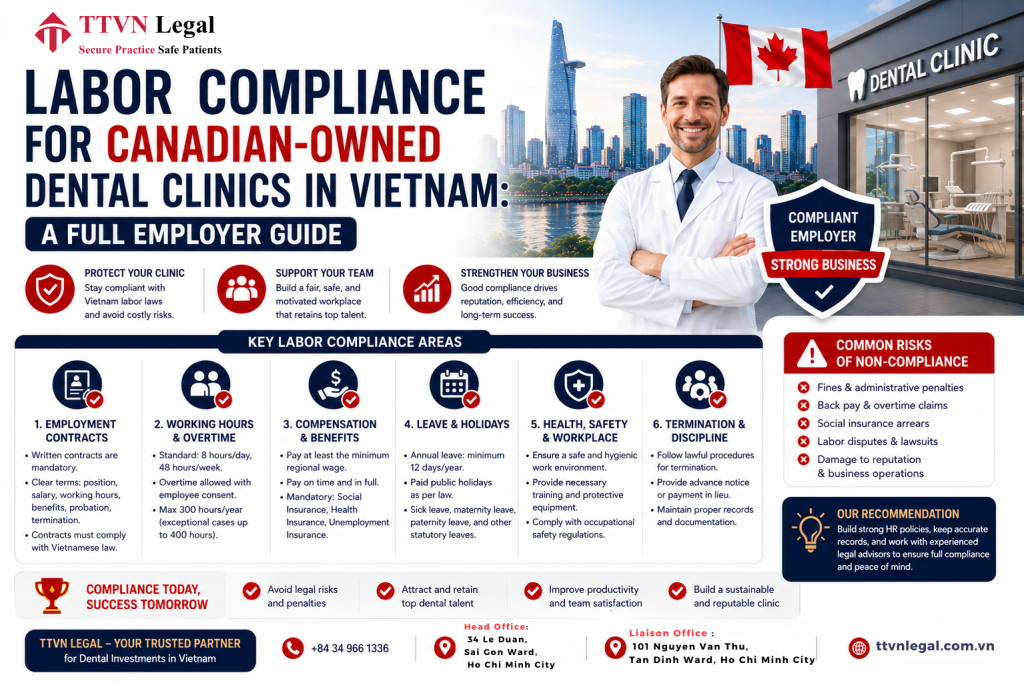
Running a dental clinic in Vietnam means being an employer—and Vietnamese employment law imposes detailed obligations on all employers, including foreign-invested companies. Canadian dental clinic owners who are familiar with Canadian employment standards will find both similarities and significant differences in the Vietnamese labor framework. Non-compliance can result in fines, labor disputes, and reputational damage that affects the clinic’s ability to recruit and retain quality clinical staff.
This guide covers the key labor compliance obligations for Canadian-owned dental clinics in Vietnam.
Employment Contracts: The Foundation of Compliance
Every person who works at a Canadian-owned dental clinic under a labor relationship must have a written employment contract (hop dong lao dong) before their first working day. Under Vietnam’s Labor Code 2019, the contract must:
Be in Vietnamese (bilingual versions are acceptable but Vietnamese governs);
Clearly state the job title and duties;
Specify the workplace (clinic address);
Define the contract type (probationary, definite-term up to 36 months, or indefinite-term);
State gross salary, payment frequency, and method;
Define working hours and rest periods;
Include social and health insurance provisions;
State termination conditions and notice requirements.
For foreign employees (including any Canadian dental professionals), the contract must also align with the scope of the work permit and the Vietnamese practice license.
Probationary Employment
Vietnamese labor law permits a probationary period of:
Maximum 180 days for positions requiring university-level qualifications or above (applicable to dentists and clinic managers);
Maximum 30 days for positions requiring technical/vocational qualifications;
Maximum 6 days for other positions.
During probation, employees are entitled to at least 85% of the agreed salary. Probationary employees cannot be included in social insurance contributions.
After probation, the employer must either confirm the employment (with a definite or indefinite-term contract) or notify the employee that the probationary period has not been passed. Failure to issue a post-probation confirmation within the probationary period results in the automatic continuation of the employment relationship.
Mandatory Social Insurance, Health Insurance, and Unemployment Insurance
All employees working under labor contracts at Vietnamese dental clinics must be enrolled in the three compulsory insurance schemes from the first month of employment:
Social insurance (bao hiem xa hoi): Covers sick leave, maternity, work accident, occupational disease, and retirement pension. Employee contribution: 8%; employer: 17.5% of monthly salary.
Health insurance (bao hiem y te): Employee contribution: 1.5%; employer: 3%.
Unemployment insurance (bao hiem that nghiep): Employee contribution: 1%; employer: 1%.
Contributions are based on monthly salary up to the maximum cap (20 times the statutory minimum wage). Late enrollment or underpayment subjects the employer to penalties and back-payment obligations with interest.
Annual Leave and Public Holiday Entitlements
Vietnamese employees at dental clinics are entitled to:
Annual leave: 12 days per year (for those with up to 5 years’ service); increasing by one additional day per 5 years of service;
National public holidays: 11 days per year (including Tet, National Day, etc.);
Sick leave: Covered by social insurance (not by the employer directly after the first 3 days);
Maternity leave: 6 months for female employees; 5–14 days for male employees.
Canadian clinic operators who plan clinic staffing and scheduling should build these entitlements into the annual workforce plan, as coverage during Tet (Vietnamese Lunar New Year) is a particularly acute challenge for healthcare facilities.
Termination and Severance Obligations
When terminating employment contracts, Canadian clinic owners must:
Provide the legally required notice period (45 days for indefinite-term; 30 days for definite-term over 12 months; 3 working days for definite-term under 12 months);
Issue severance pay (tro cap thoi viec) to employees with 12+ months of service: 0.5 months’ salary per year of service (for years before December 2008) or covered by unemployment insurance (for years after);
Provide a confirmation of employment letter and deliver the employee’s social insurance book within 14 working days of termination.
Wrongful termination (without a legally recognized reason and proper procedure) requires the employer to pay: reinstatement salary for the invalid termination period, plus two months’ salary as compensation, plus severance if applicable.
Managing Foreign Dental Staff: Work Permit Compliance
For any foreign dental professionals (including Canadian dentists, dental assistants, or clinic managers from outside Vietnam):
A work permit is mandatory before starting work. Operating without one subjects both the employer and the employee to fines.
Work permits are issued for a maximum of 2 years and must be renewed in advance.
The work permit specifies the employer and position—a foreign employee cannot work at a different clinic or in a different role without a work permit amendment.
The employer must report the foreign employee’s commencement of work to DOLISA within 3 working days.
Work permit exemptions are narrow—verify eligibility before assuming an exemption applies.
Conclusion
Labor compliance for Canadian-owned dental clinics in Vietnam requires systematic attention to employment contracts, mandatory insurance contributions, leave entitlements, termination procedures, and work permit management for foreign staff. A structured HR compliance program—ideally managed with the support of a Vietnamese employment lawyer—is the most effective risk mitigation approach. TTVN Legal advises Canadian dental clinic operators on all aspects of Vietnamese employment law.
Need expert legal support for healthcare investment in Vietnam? TTVN Legal | 101 Nguyen Van Thu, Tan Dinh Ward, Ho Chi Minh City, Vietnam +84 349661336 | tham@ttvnlegal.com.vn | https://ttvnlegal.com.vn/