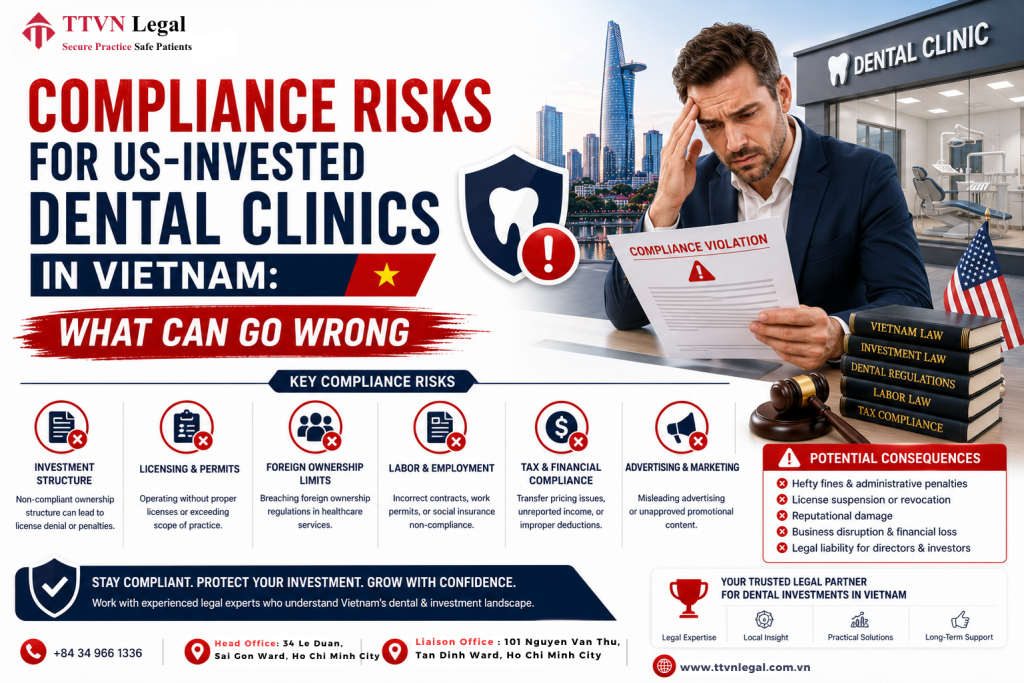
Even well-intentioned US dental investors can find themselves facing significant compliance risks in Vietnam if they underestimate the complexity of the regulatory environment. Violations can result in fines, suspension of the operating license, revocation of practitioner licenses, and in serious cases, criminal liability. Understanding the most common compliance risks—and how to mitigate them—is essential for every US-invested dental clinic.
This guide identifies the highest-risk compliance areas for US dental clinics in Vietnam and provides practical mitigation strategies.
Risk 1: Operating Without or Beyond the Licensed Scope
The healthcare operating license specifies exactly which dental services the clinic may provide. Offering services outside this scope—whether due to an unplanned expansion of clinical offerings or an administrative oversight—is one of the most common and serious compliance violations.
Examples:
A clinic licensed for general dentistry begins offering implant surgery without first amending the operating license to include implant procedures and a dedicated implant room.
A dental clinic offers orthodontic services under a responsible director whose practice license does not cover orthodontics.
A clinic advertises and provides teeth whitening as a medical service but without the appropriate clinical credentials.
Mitigation: Conduct a quarterly review of all services offered against the operating license scope. Any new service line must trigger a license amendment application before the service is offered to patients.
Risk 2: Responsible Director Compliance Failures
The responsible clinical director is the clinic’s primary regulatory interface. Compliance failures related to this role are disproportionately high-impact:
The responsible director’s Vietnamese practice license expires and is not renewed—the clinic cannot legally operate without a validly licensed responsible director;
The responsible director is absent from the clinic during operating hours without an authorized deputy arrangement;
The responsible director simultaneously serves in the same role at three or more facilities (violating the two-facility maximum);
The responsible director’s scope of practice does not cover all services the clinic is offering.
Mitigation: Maintain a compliance calendar tracking the responsible director’s license expiry, work permit expiry, and attendance requirements. Have a contingency plan for responsible director absence.
Risk 3: Radiation Safety Non-Compliance
Dental clinics using X-ray equipment (panoramic, periapical, or cone-beam CT) face specific radiation safety compliance requirements under Circular 59/2025/TT-BKHCN that are strictly enforced:
Radiation practice permit from the provincial Department of Science and Technology must be obtained and renewed;
Individual radiation dose monitoring records must be maintained for all radiation-exposed staff;
Lead shielding must meet 0.5mm lead equivalent minimum;
X-ray operators must hold current radiation safety training certificates;
Equipment calibration and inspection must be documented.
Mitigation: Appoint a designated radiation safety officer for the clinic, maintain a radiation compliance file, and set renewal reminders for the radiation practice permit and staff training certificates.
Risk 4: Infection Control Deficiencies
MOH inspections of dental clinics frequently identify infection control deficiencies under Decision 5991/QD-BYT. Common deficiencies include:
Inadequate sterilization documentation (missing autoclave cycle logs, biological indicator records);
Improper storage of sterile instruments;
Non-compliant hand hygiene protocols;
Inadequate environmental cleaning records;
Failure to conduct and document annual infection control training for all staff.
Mitigation: Implement a structured infection control management system with documented SOPs, regular internal audits, and real-time cycle logging for sterilization equipment. Annual mock inspections using the MOH’s own inspection checklist are highly effective preparation.
Risk 5: Labor Compliance Violations
US-invested dental clinics frequently face labor compliance violations that may seem minor but can trigger inspections across all compliance domains:
Employment contracts not signed before the employee’s first day of work;
Social insurance contributions not enrolled within 30 days of employment start;
Overtime hours not compensated at the legally required premium rates;
Foreign employees working without valid work permits or under expired work permits;
Failure to file termination paperwork with DOLISA when employees leave.
Mitigation: Use a HR compliance calendar for all labor obligation deadlines; never allow an employee to start work without a signed contract and verified work permit (for foreign staff); conduct biannual HR compliance audits.
Risk 6: Advertising and Marketing Non-Compliance
Vietnam’s healthcare advertising regulations—governed by the Law on Advertising 2012 and MOH circulars—impose specific restrictions on dental clinic marketing:
Before-and-after photos may only be used with MOH approval;
Price advertising must comply with permitted formats;
Claims about treatment outcomes must be evidence-based and approved;
Foreign-language advertising must have Vietnamese translations;
Social media promotions may require specific approvals.
Mitigation: Have all advertising materials reviewed by a Vietnamese healthcare lawyer before publication. This is particularly important for US dental clinics that use aggressive digital marketing strategies common in the US market but potentially non-compliant in Vietnam.
Conclusion
US-invested dental clinics in Vietnam face compliance risks across multiple regulatory domains, any one of which can result in serious sanctions. A proactive compliance program—covering operating license scope, responsible director management, radiation safety, infection control, labor law, and advertising—is the most effective risk mitigation strategy. TTVN Legal provides compliance risk assessment and management advisory services for US dental clinic operators in Vietnam.
Need expert legal support for healthcare investment in Vietnam? TTVN Legal | 101 Nguyen Van Thu, Tan Dinh Ward, Ho Chi Minh City, Vietnam +84 349661336 | tham@ttvnlegal.com.vn | https://ttvnlegal.com.vn/