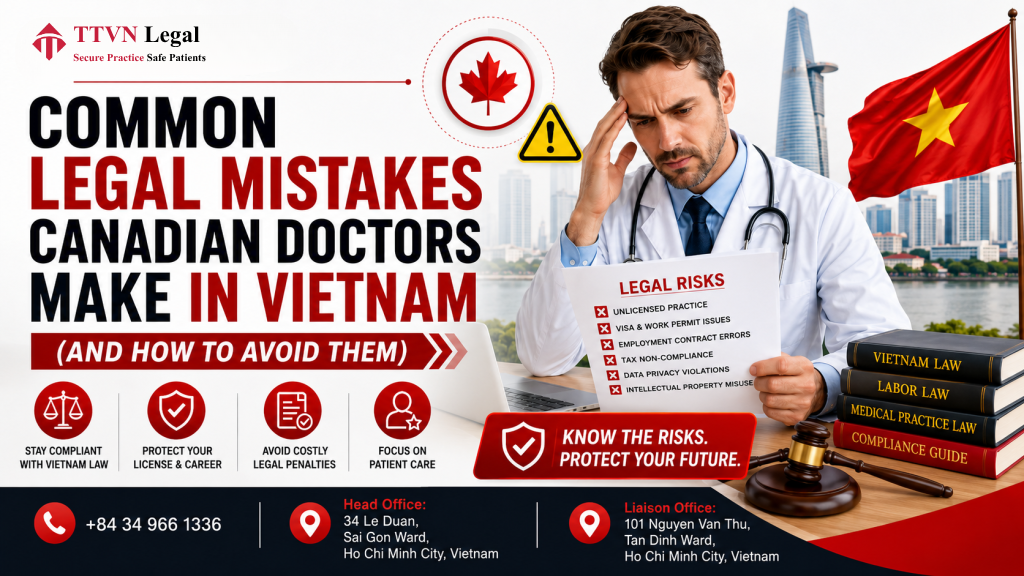
Vietnam’s healthcare regulatory environment is complex, and even well-prepared Canadian physicians frequently make legal missteps that result in delays, fines, and in the most serious cases, clinical practice interruptions. This guide identifies the most common legal mistakes Canadian doctors make when practicing in Vietnam—and explains how to avoid each one, with reference to the applicable legal framework under the Law on Medical Examination and Treatment 2023 and Decree 96/2023/ND-CP.
Mistake 1: Starting Clinical Work Before the License Is Issued
The most serious and surprisingly common mistake is commencing clinical practice before the Vietnamese medical practice license is in hand. Under the Law on Medical Examination and Treatment 2023, any individual providing medical examination and treatment services in Vietnam without a valid license is subject to administrative sanctions, including fines and prohibition from future practice.
Canadian doctors sometimes begin seeing patients under informal arrangements with the hospital (e.g., ‘assisting’ a licensed Vietnamese doctor in consultations) while waiting for their own license. This is not a legally recognized arrangement and does not shield the Canadian doctor from liability.
The correct approach: Do not enter any clinical role until both the work permit and the Vietnamese practice license are in hand. Any pre-license activity should be restricted to non-clinical administrative, research, or training roles explicitly permitted by the employment contract.
Mistake 2: Practicing Outside the Licensed Scope
A Vietnamese practice license specifies a scope of practice. Performing clinical activities outside that scope—even if within the Canadian doctor’s competence and Canadian license—is unlawful in Vietnam.
Examples of scope violations:
A Canadian cardiologist performing a dermatological procedure;
A Canadian GP providing specialist-level obstetric care at a clinic not licensed for obstetrics;
A Canadian specialist performing procedures not covered by the facility’s operating license.
Canadian doctors must review their Vietnamese license’s stated scope carefully before agreeing to any clinical role and should decline requests from hospital management to perform activities outside that scope, regardless of the clinical circumstance.
Mistake 3: Neglecting Work Permit Renewal
A work permit (giay phep lao dong) is typically issued for a maximum of 2 years and must be renewed. Continuing to work after a work permit expires makes the employment unlawful, exposes the employer to fines, and creates grounds for immediate termination of the employment contract.
Canadian doctors often leave work permit renewal management entirely to hospital HR departments—and then find themselves without a valid permit because HR missed the deadline or the renewal application was incomplete.
Best practice: Personally track work permit expiry dates; initiate the renewal process at least 60–90 days before expiry; and independently verify (rather than simply trust HR’s assurance) that the renewed permit has been issued before the old one expires.
Mistake 4: Failing to Update the License After a Facility Change
A Vietnamese medical practice license specifies the healthcare facility at which the doctor is registered. Changing employers—even to a facility in the same city—requires an amendment to the practice license to reflect the new registered facility.
Many Canadian doctors who change hospitals assume their existing license covers their new position. It does not. Until the license is amended to reflect the new facility, the doctor technically lacks authorization to practice at the new location.
The amendment process is less burdensome than the original license application, but still requires a formal application to the provincial Department of Health and a processing period.
Mistake 5: Ignoring Vietnamese Language Requirements
The Law on Medical Examination and Treatment 2023 requires that patient-facing clinical activities be conducted in Vietnamese, or with a qualified interpreter for foreign-language patients. Canadian doctors who conduct consultations, document clinical notes, or obtain informed consent solely in English—without a qualified interpreter for Vietnamese-speaking patients—are in breach of this requirement.
In practice, international hospitals manage this through bilingual clinical staff. But Canadian doctors working in mixed-language clinical environments should:
Confirm interpreter availability before any clinical interaction requiring informed consent;
Ensure clinical documentation is maintained in Vietnamese (or bilingual) as required by the facility;
Not rely on untrained staff (such as administrative assistants) as medical interpreters for complex clinical communication.
Mistake 6: Underestimating the Malpractice Documentation Requirement
Canadian doctors accustomed to the Canadian medical documentation environment sometimes underestimate the importance of contemporaneous, detailed clinical records in the Vietnamese context.
In Vietnamese malpractice proceedings, the absence of a clear record of informed consent, differential diagnosis reasoning, and treatment rationale is treated as prima facie evidence of negligence. Verbal consent, informal agreements, and undocumented clinical decisions that might be acceptable in a Canadian private clinic context are legally risky in Vietnam.
All clinical encounters should be documented in real time, informed consent should be obtained in writing (with witness where appropriate), and records should be maintained for the statutory retention period.
Conclusion
The most common legal mistakes by Canadian doctors in Vietnam are preventable with proper pre-employment legal advice, rigorous compliance management, and ongoing attention to licensing and documentation requirements. Vietnam’s regulatory framework rewards physicians who are thorough and proactive. TTVN Legal provides pre-deployment legal briefings and ongoing compliance advisory for Canadian doctors in Vietnam.
Need expert legal support for healthcare investment in Vietnam? TTVN Legal | 101 Nguyen Van Thu, Tan Dinh Ward, Ho Chi Minh City, Vietnam +84 349661336 | tham@ttvnlegal.com.vn | https://ttvnlegal.com.vn/