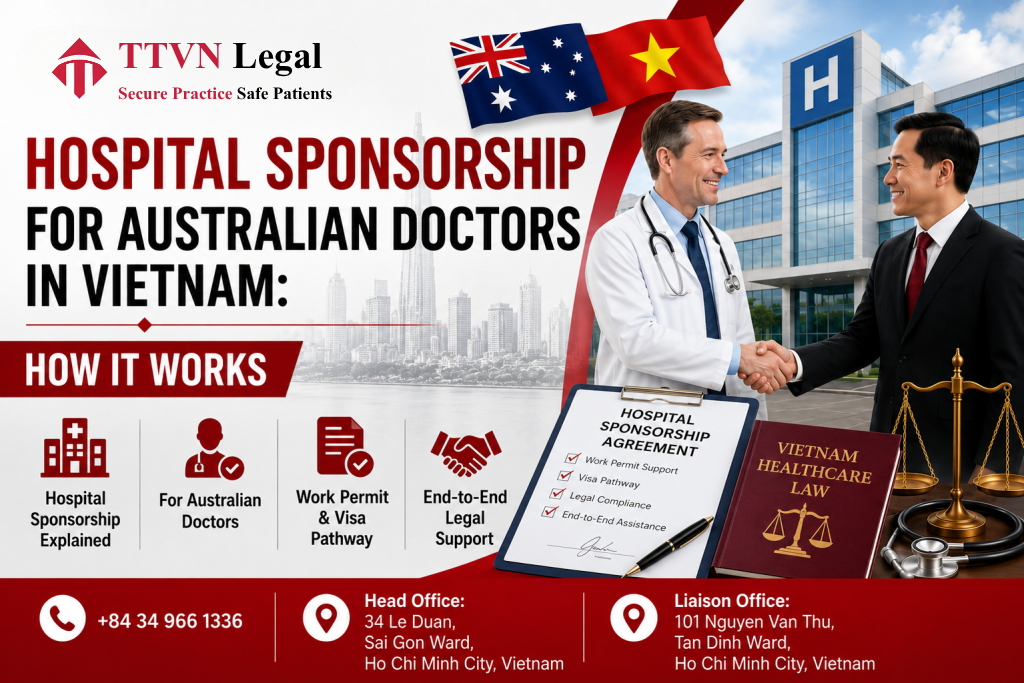
Many Australian physicians seeking to practice in Vietnam enter the market through hospital sponsorship—an arrangement where a Vietnamese hospital facilitates the work permit, employment contract, and licensing process for the foreign doctor. This model is common at international-standard private hospitals that actively recruit Australian specialists and GPs for their patient communities.
This guide explains how hospital sponsorship works in Vietnam, what it covers, what it does not cover, and what Australian doctors should watch for when entering a sponsored employment arrangement.
What Hospital Sponsorship Means Legally
In the Vietnamese context, ‘hospital sponsorship’ refers to the practice where a Vietnamese healthcare employer formally supports a foreign doctor’s work permit application and coordinates the licensing process. There is no single legal document called a ‘sponsorship agreement’—the sponsorship relationship is expressed through:
A signed employment contract between the Australian doctor and the hospital entity.
The hospital’s application on behalf of the doctor for a work permit (giay phep lao dong) under Decree 152/2020/ND-CP.
The hospital’s provision of required employer declarations and certifications needed for the medical license recognition dossier.
Where applicable, the hospital’s support of the Australian doctor’s Temporary Residence Card (TRC) application.
The employment contract is the foundational document of the sponsorship relationship and must meet all requirements of Vietnam’s Labor Code 2019.
What a Hospital Sponsor Typically Provides
International hospitals in Vietnam offering sponsorship to Australian doctors generally provide:
Work permit application support: The hospital’s HR or legal team prepares and files the work permit application with the provincial DOLISA. This includes providing the ‘certificate of need for foreign labor’ (xac nhan nhu cau su dung lao dong nuoc ngoai), which must be obtained before the work permit can be issued.
Document coordination: Assistance with collecting and preparing employer-side documents needed for the medical license recognition dossier submitted to the MOH under Articles 29 and 30 of the Law on Medical Examination and Treatment 2023.
Visa facilitation: Coordination of the LD (work) visa or Temporary Residence Card application once the work permit is issued.
Administrative liaison: Acting as the point of contact with Vietnamese regulatory authorities throughout the licensing process.
Cost coverage: Many international hospitals cover apostille and translation costs, application fees, and legal advisory fees as part of the employment package.
What Sponsorship Does NOT Cover
Australian doctors should understand the limits of hospital sponsorship:
The Australian doctor must personally satisfy the conditions for license recognition under Article 29 of the 2023 Law—the hospital cannot substitute for the doctor’s qualifications, clean criminal record, or health status.
The MOH recognition decision is issued to the individual doctor, not the hospital. If the doctor changes employers, the recognition decision remains valid but a new work permit and (in some cases) a license amendment may be required.
The Vietnamese practice license (giay phep hanh nghe) is individual and non-transferable. It specifies the professional title, scope of practice, and facility of registration.
If the employment relationship ends, the work permit is generally cancelled, and the Australian doctor’s right to practice at that facility ceases. Continuing to practice without a valid work permit is unlawful.
Hospital sponsorship does not guarantee renewal of work permits or licenses—renewal must be actively managed before expiry.
Scope of Practice and Hospital Operating License Alignment
A critical and often overlooked aspect of hospital sponsorship is the requirement that the Australian doctor’s practice scope align with the hospital’s operating license. Under Decree 96/2023/ND-CP, healthcare facilities may only offer services within their licensed scope.
If an Australian cardiologist joins a hospital whose operating license does not include cardiology services, the doctor cannot legally perform cardiological procedures at that facility—regardless of their individual Vietnamese practice license. Australian doctors should review the hospital’s operating license scope before accepting a sponsored position.
Negotiating a Sponsorship Employment Contract
Australian doctors entering a hospital sponsorship arrangement should negotiate key provisions in the employment contract:
Who bears the cost of credential recognition (apostilles, certified translations, MOH filing fees, legal advisory)?
What happens to the work permit and visa if the hospital’s operating license is suspended or revoked?
What are the terms for license renewal support at the end of the initial work permit period?
What professional liability insurance does the hospital provide, and what are its coverage limits?
Is there a probationary clause, and what are the conditions for confirmation of permanent employment?
What are the notice periods and severance provisions?
Australian doctors should have an independent Vietnamese labor lawyer review any hospital sponsorship contract before signing.
Changing Sponsors: What Happens If You Switch Hospitals
Australian doctors who wish to change their sponsoring hospital in Vietnam face a structured process:
The existing work permit is cancelled upon termination of the employment relationship.
A new work permit must be applied for with the new hospital as sponsor.
If the scope of practice at the new hospital differs from the current license scope, a license amendment or fresh application may be required.
The MOH recognition decision (from the original licensing process) remains valid and does not need to be re-obtained, significantly reducing the time needed for the new licensing application.
In practice, experienced Australian doctors who have already completed the recognition process can transition between hospital employers in approximately 4–8 weeks, assuming a complete and compliant new work permit application.
Conclusion
Hospital sponsorship is the most common and practical pathway for Australian doctors to enter Vietnam’s healthcare workforce. It provides essential administrative support but does not eliminate the need for individual compliance with Vietnamese licensing law. Australian doctors should understand both what their sponsor provides and what their own personal obligations are. TTVN Legal advises Australian physicians and their hospital employers on structuring compliant sponsorship arrangements.
Need expert legal support for healthcare investment in Vietnam? TTVN Legal | 101 Nguyen Van Thu, Tan Dinh Ward, Ho Chi Minh City, Vietnam +84 349661336 | tham@ttvnlegal.com.vn | https://ttvnlegal.com.vn/