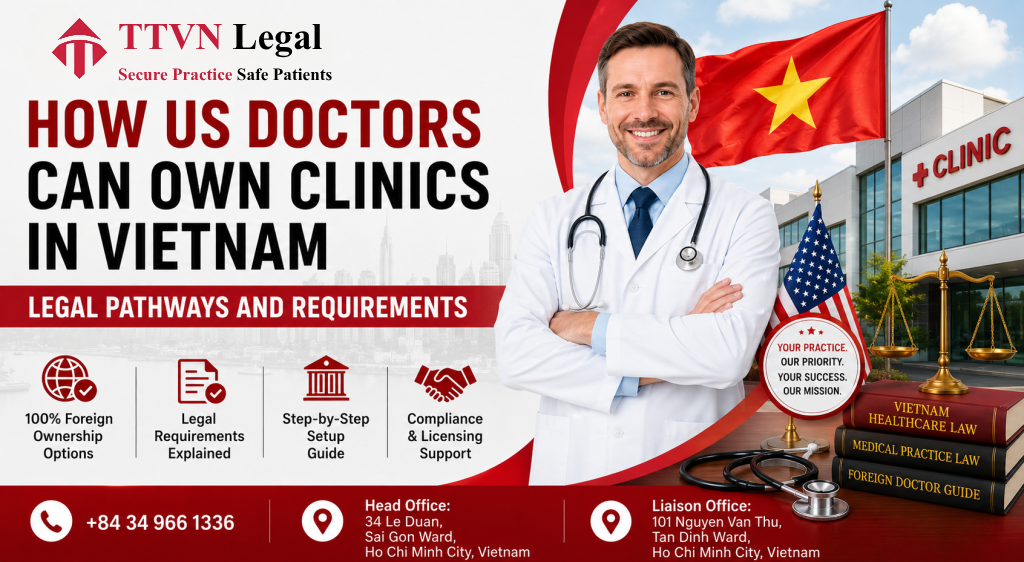
The idea of a US-trained physician owning and operating a clinic in Vietnam is not only legally possible—it is increasingly common as Vietnam’s private healthcare sector matures. However, the path from holding a US medical license to opening the doors of a compliant Vietnamese clinic involves navigating both foreign investment law and the rigorous healthcare licensing framework.
This guide explains the complete legal pathway for US doctors who want to own clinics in Vietnam, covering the structure of permitted ownership, licensing requirements, facility standards, and practical planning considerations.
The Legal Distinction Between Ownership and Practice Rights
A US doctor must understand from the outset that owning a clinic and having the right to practice medicine within it are governed by two separate legal frameworks. Ownership of the clinic entity falls under the Law on Investment 2025 and the Law on Enterprises 2020 as amended 2025. The right to personally provide medical services falls under the Law on Medical Examination and Treatment 2023.
This distinction matters because a US doctor can begin the company registration process (and even construct the facility) before their Vietnamese practice license is issued—but they cannot legally see patients until their individual practice license in hand.
Investment Structure: How to Own the Clinic
Vietnam permits 100% foreign ownership of outpatient medical clinics by foreign investors, including US citizens. The typical investment structure is a single-member limited liability company. The steps are:
1. Either Apply for an Investment Registration Certificate (IRC) from the provincial Department of Finance first and then Register the enterprise and obtain an Enterprise Registration Certificate (ERC) or vice versa. 2. Open a direct investment capital account and transfer charter capital.
The miminum capital investment for outpatient clinic is US$200.000
Individual Practice License: The Non-Negotiable Prerequisite
Even as the 100% owner of the clinic, a US doctor cannot practice medicine without a Vietnamese medical practice license (giay phep hanh nghe). Under Articles 29 and 30 of the Law on Medical Examination and Treatment 2023, and Articles 13, 14, 37, and 38 of Decree 96/2023/ND-CP, the process requires:
Recognition of the US medical license by the Vietnamese Ministry of Health (MOH) under Article 29 of the 2023 Law. This involves submitting a dossier to the Department of Medical Services Administration and awaiting a recognition decision (30 days if the US state board is already recognized by MOH; potentially 3–6 months if assessment is required).
Application for a Vietnamese practice license under Article 30, submitted to the provincial Department of Health where the clinic is located (Article 7, Decree 148/2025/ND-CP). Processing: 30 days from receipt of a complete dossier.
During the period before the US doctor’s individual license is issued, the clinic must appoint a locally licensed physician as the responsible clinical director (nguoi chiu trach nhiem chuyen mon) in order to obtain the facility operating license.
Facility Operating License: Standards US Doctors Must Meet
A specialty outpatient clinic (phong kham chuyen khoa) owned by a US doctor must obtain a healthcare operating license (giay phep hoat dong). Under Decree 96/2023/ND-CP, the facility must meet minimum standards including:
Fixed location complying with structural safety, fire prevention (Decree 105/2025/ND-CP), infection control (Decision 5991/QD-BYT), and environmental protection requirements.
Examination room of at least 10 m2; dedicated procedure room of at least 10 m2 if procedures are performed.
Sterilization area for reusable instruments.
Anaphylaxis emergency kit and specialty-appropriate emergency medications.
Appropriate signage, floor plan, and patient guides.
If radiation equipment (e.g., X-ray) is used: radiation safety permit from the provincial Department of Science and Technology under Circular 59/2025/TT-BKHCN.
The responsible clinical director must hold a Vietnamese practice license in the relevant specialty and have at least 54 months of post-graduation clinical experience.
Responsible Clinical Director: Key Role for US Doctor-Owners
For US doctors who are both the owner and the primary clinician, the responsible clinical director role is central. Once the US doctor has obtained their Vietnamese practice license, they can assume this role themselves—eliminating the need for a separately appointed director. This is often the preferred structure for solo-practitioner clinics.
However, the responsible director must be physically present at the clinic during operating hours and cannot simultaneously hold the same role at more than one additional facility. US doctor-owners planning to operate multiple clinic locations must plan their staffing accordingly.
Conclusion
US doctors can legally own and operate clinics in Vietnam, benefiting from the country’s 100% foreign ownership framework for healthcare investment. The key is understanding that ownership rights and clinical practice rights are separate legal matters requiring sequential but coordinated action. TTVN Legal supports US physician-investors from the initial feasibility stage through to the first day of patient care.
Need expert legal support for healthcare investment in Vietnam? TTVN Legal | 101 Nguyen Van Thu, Tan Dinh Ward, Ho Chi Minh City, Vietnam +84 349661336 | tham@ttvnlegal.com.vn | https://ttvnlegal.com.vn/